PARIS · EST. 2013
Plan an Eiffel Tower Proposal in Paris: Public or Private?
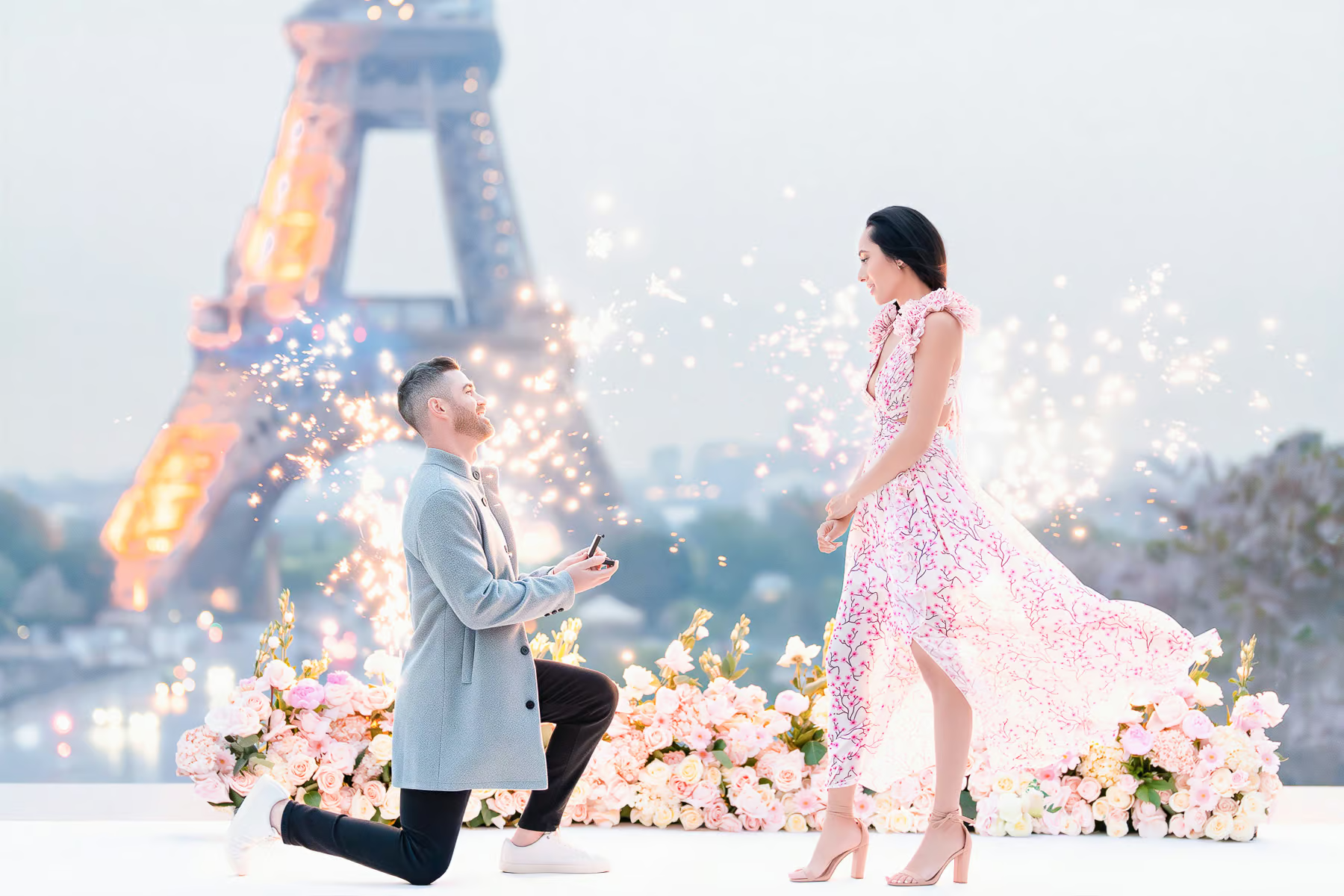
You have decided to propose in Paris and you want the Eiffel Tower involved. The first decision is whether you ask in a public place with the Tower behind you or reserve a private Eiffel Tower setting.
As Seen In




Chapters
This guide is built around the questions our clients ask most: what public really means at Trocadéro and the other well-known positions, what privacy costs, how the Tower will look in your photographs, when to plan around its lights, what rain changes, and what should happen after she says yes. Read it from the top if you are still comparing. If you already know what you need, use the jump tabs on the right to go directly to the section you need. They stay on the right on a phone as well as a desktop.
A public proposal can be simple. Choose the right location and hour, have an experienced photographer waiting, ask, and continue into engagement photographs. You pay nothing to rent the setting, and Paris does not stop for you. A private proposal adds the cost of reserved access and gives you control over who is there, what can be prepared before you arrive, where the photographer and filmmaker work, whether family can wait out of sight, and what happens in the hour after she says yes. Private can mean a residential rooftop, a terrace reserved for a defined period, an Eiffel-facing room or suite, or a boat on the Seine.
A simple public proposal with a good photographer remains the least expensive route to an Eiffel Tower engagement. Once you add décor, film, music, lighting, transport, and coordination, private options are often much closer in price than you would assume. The cost comparison is further down.
If you are still deciding whether the Eiffel Tower belongs in the proposal at all, start with our Paris proposal guide. This page begins once the answer is yes.
Should your Eiffel Tower proposal be public or private?
Choose public when you want a relatively simple proposal, the Tower in the photographs, and you do not mind other people being around you while you ask. Choose private when control over the proposal area, the preparation, family, or the time immediately afterward is worth paying for.
| What changes | Public | Private |
| Privacy | Open to everyone else | No unrelated public in the reserved area |
| Cost | No venue fee. Production still costs money | Reserved access adds cost, though entry packages already include setup and photography |
| Crowds | Depend on the position and the hour | No public crowd in the reserved area |
| Setup | Keep it light. Permissions can matter | Prepared before you arrive, subject to venue access and rules |
| Family | Hard to hide and hard to time | Easier to stage, subject to capacity |
| Photography | The team works around the public | Positions and light can be worked out in advance |
| Weather | No indoor fallback attached | Depends on the venue or vessel |
| After the yes | You leave, for photographs, brunch, dinner, or your hotel | Champagne, dinner, a cruise, or the night, depending on the setting |
Neither column is the better proposal. They are different days, and the honest comparison is at the finished price rather than the venue fee.
What is a public Eiffel Tower proposal really like?
It is beautiful, it is unpredictable, and the setting is not yours to control.
Around the Tower you will find tourists, groups of young Parisians, street vendors, other couples, proposal photographers working, people smoking, phones pointed in your direction, and ordinary city movement going on while you are on one knee. Sometimes that becomes part of the pleasure of it. A group works out what is happening and starts cheering, someone applauds when she says yes, a stranger shouts congratulations, and the couple laughs about it for years. Another woman would find exactly the same attention mortifying, and that is the first thing to think about. If your partner dislikes being the center of attention, the most famous viewpoint in Paris may be the wrong place to ask her, however much you like the photograph.
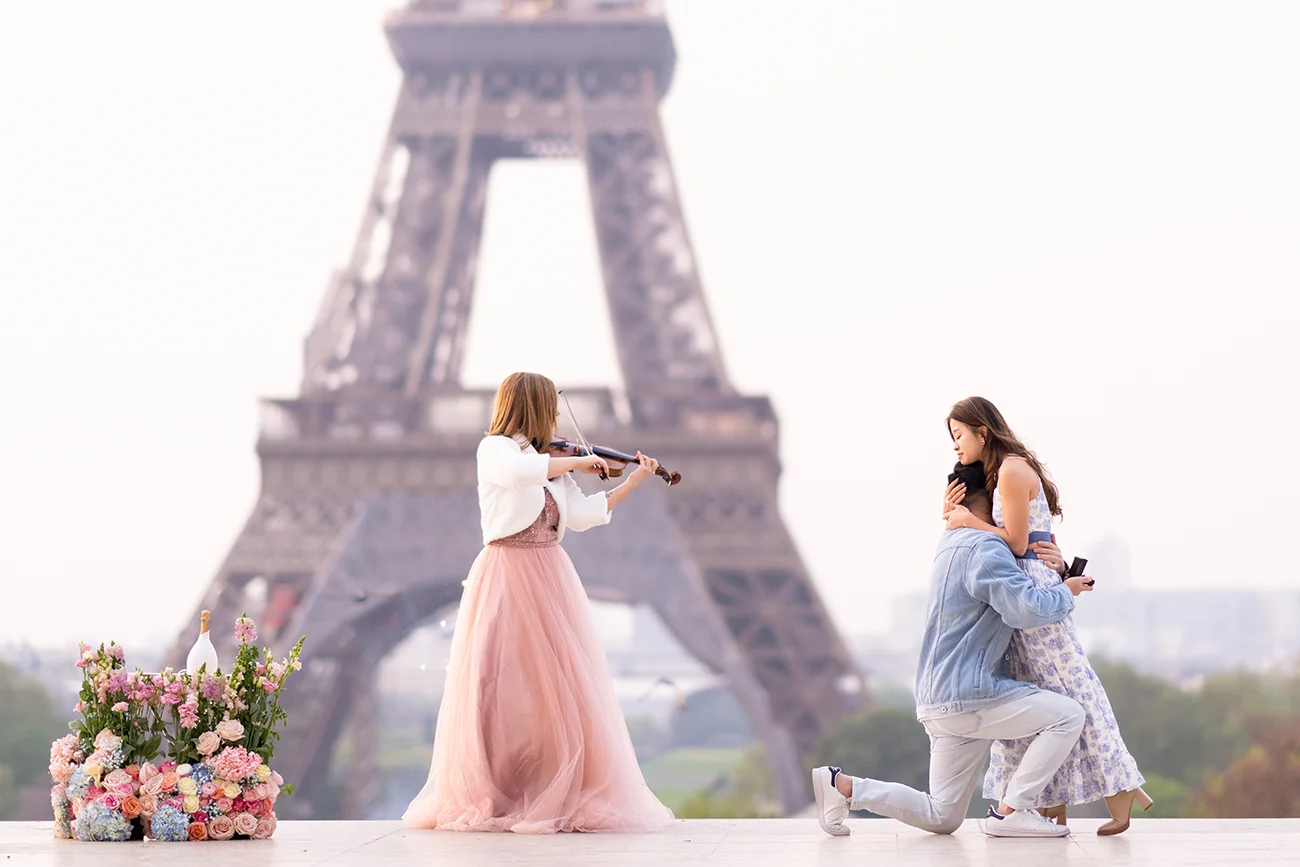
The practical details matter too. Paris has cobblestones, steps, uneven ground, cigarette ends, litter, and the occasional broken bottle. Someone may walk through the frame. Another photographer may position a couple a few meters from you and start shooting before you have finished. At a well-known position you may arrive to find somebody standing exactly where you meant to ask. And if she is in the heels she chose because she believes you are going to dinner, plan the approach as carefully as the photograph: ten uncomfortable minutes over cobblestones still happened, even when the final image is beautiful.
A public proposal needs a crowd plan
Timing is the first tool, the exact position is the second, and an experienced local photographer is the third.
At a heavily used public location, it also helps to have someone from the team arrive ahead of you. They can see what the location looks like that morning, check the immediate area, warn the photographer about an obstruction or an unexpected crowd, and help time your arrival so that you are not standing about while she wonders what you are waiting for.
They are not security. They cannot reserve a public platform, clear everyone out of it, or ask strangers to wait indefinitely while you deliver a ten-minute speech. If another photographer and couple are next in line, a friendly team member can usually ask for a few minutes, which is a different thing from expecting a public viewpoint to behave like a private terrace. The proposal should never feel rushed because somebody is waiting, so in a heavily used spot the sequence needs to be organized well enough that the plan does not depend on the rest of Paris standing still.
What does a large public setup buy you?
It buys décor and production. It does not buy control of the space around you.
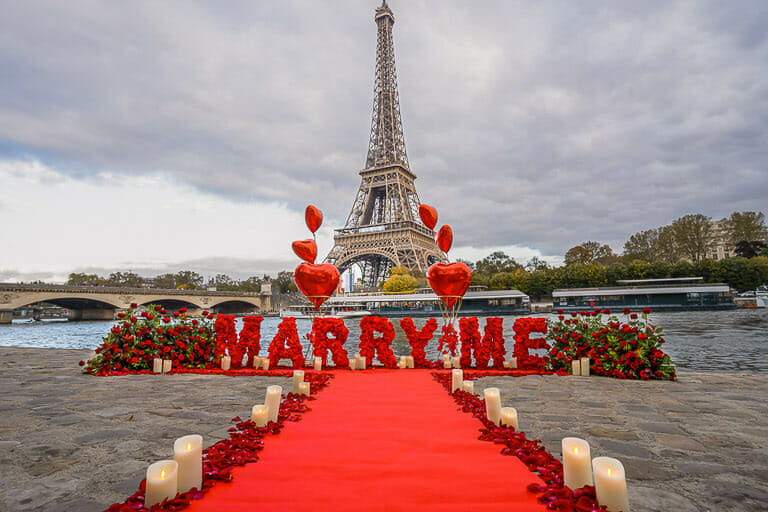
Along the popular stretches you will see illuminated MARRY ME letters, floral hearts, carpets, candles, and musicians. They photograph well. They also look remarkably alike when several are installed within sight of each other, and on a busy evening you can end up proposing with the neighboring production’s violinist playing over your own, among cigarette ends and broken glass, while the couple beside you starts their photographs before you have finished yours.
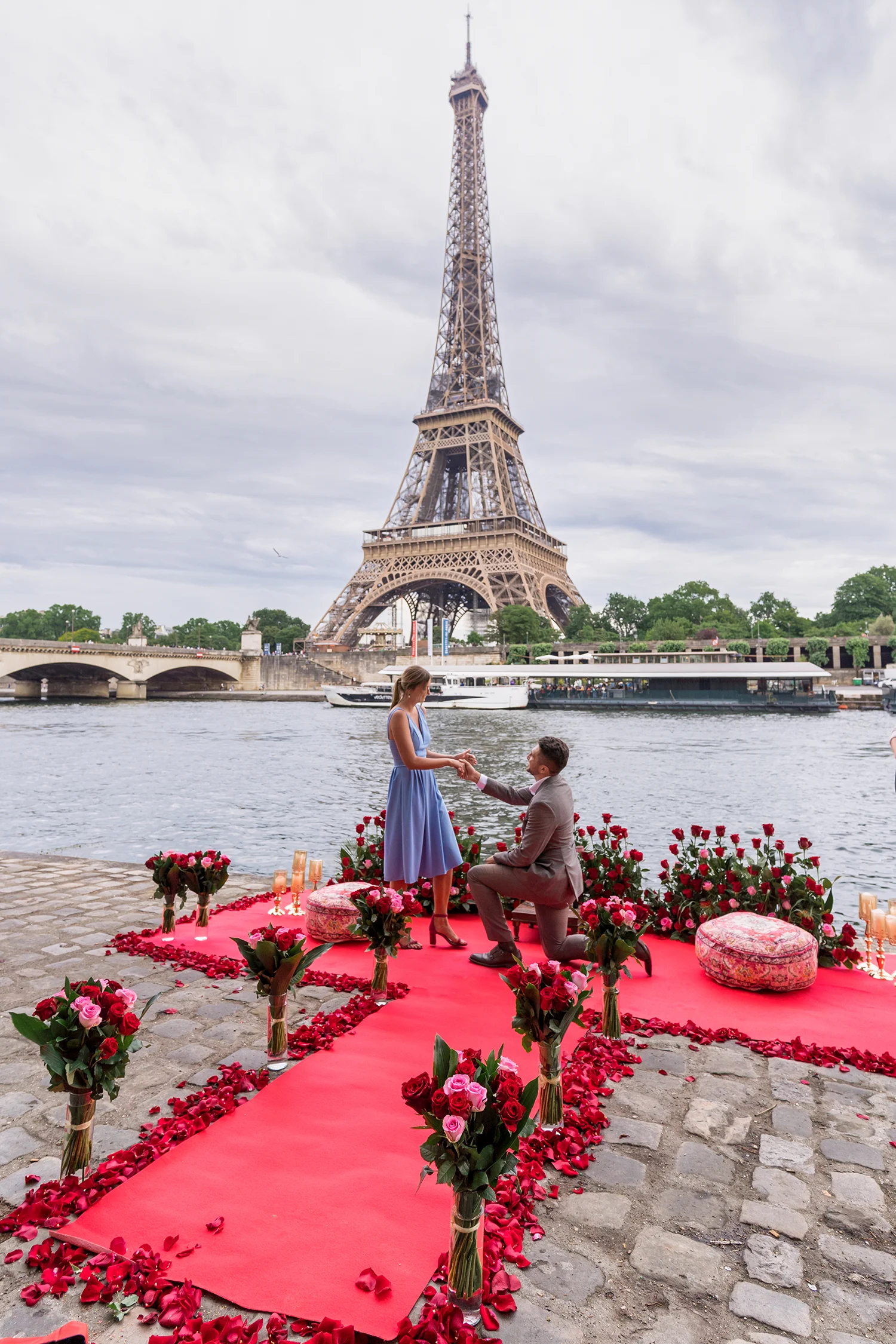
Every one of those setups is delivered and installed for the booking, so that is not the issue. What matters is the condition of what arrives. A carpet that several hundred couples have already stood on shows it: worn patches where everyone stands, and marks from shoes, spilled champagne, and wet rose petals that do not come out. Petals vary more than people expect, and the cheapest are used again and again until they look like what they are. A true red is the first thing to go.
So ask how old the carpet is, how many couples have used it, and whether the petals are new for your proposal. If your partner would love the letters and the floral heart, use them and enjoy them. Spending more on the décor does not change the privacy of the space around it, and it does not tell you what condition the décor is in.
What are the rules for public Eiffel Tower setups?
They depend on the exact location and on the scale of what you are installing, filming, or bringing into the space.
The answer changes with the crew, the lighting, music, furniture, floral structures, equipment, vehicle access, and how much public ground is being occupied. We have watched the commonly used areas along the Seine become more controlled over time, including changes to the vehicle access once used to bring installations close to the spot. A setup you saw somewhere last week is not permission for yours on your date.
For a photographer-led proposal the logistics stay light. For a substantial public production, we confirm the current conditions for the exact place and plan rather than building your proposal around somebody else’s Instagram post.
Which public Eiffel Tower location suits you?
The right one depends on the photograph you want, how much public activity you can live with, what time you can realistically arrive, and how she is going to get there.
Trocadéro: our first choice for the classic view
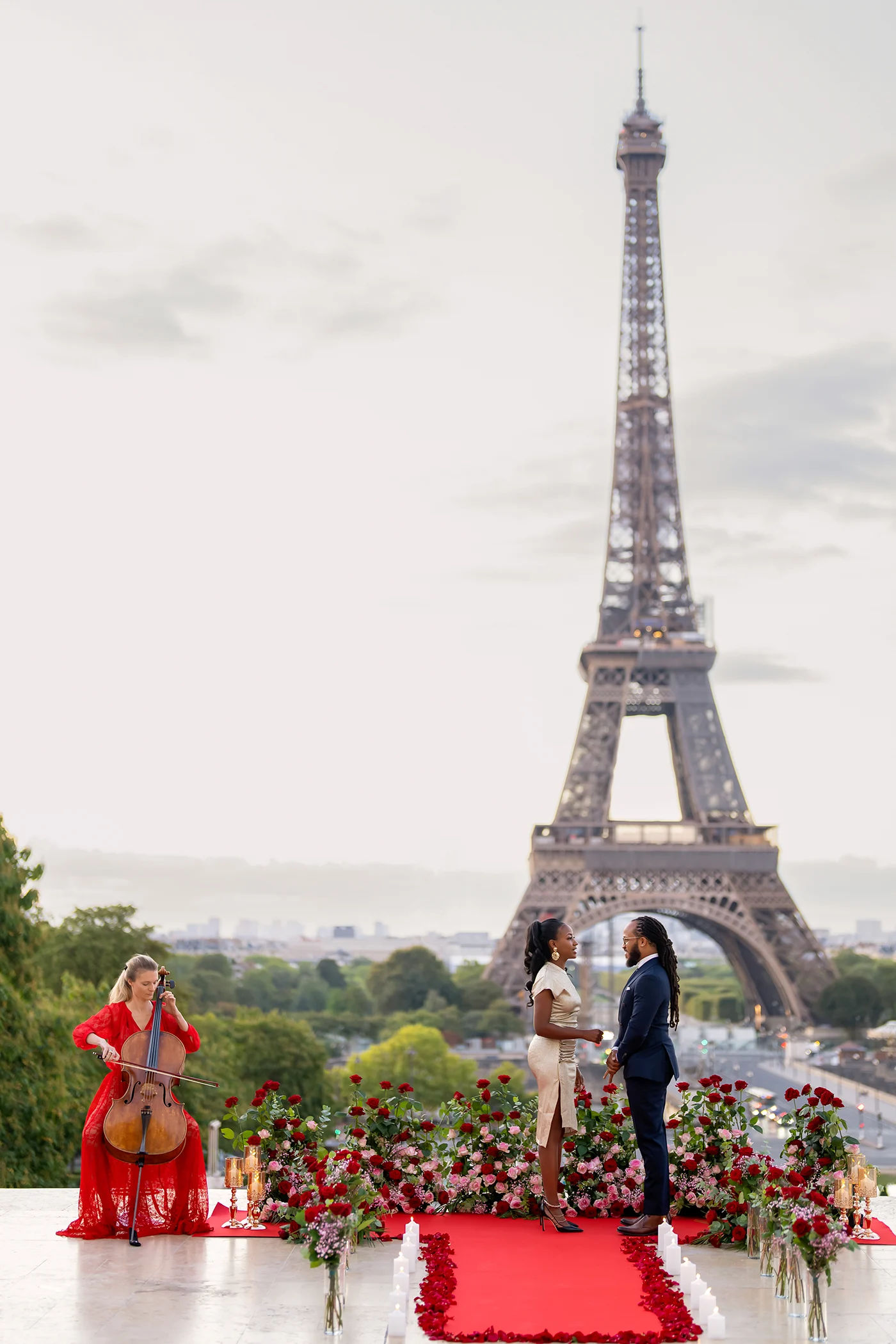
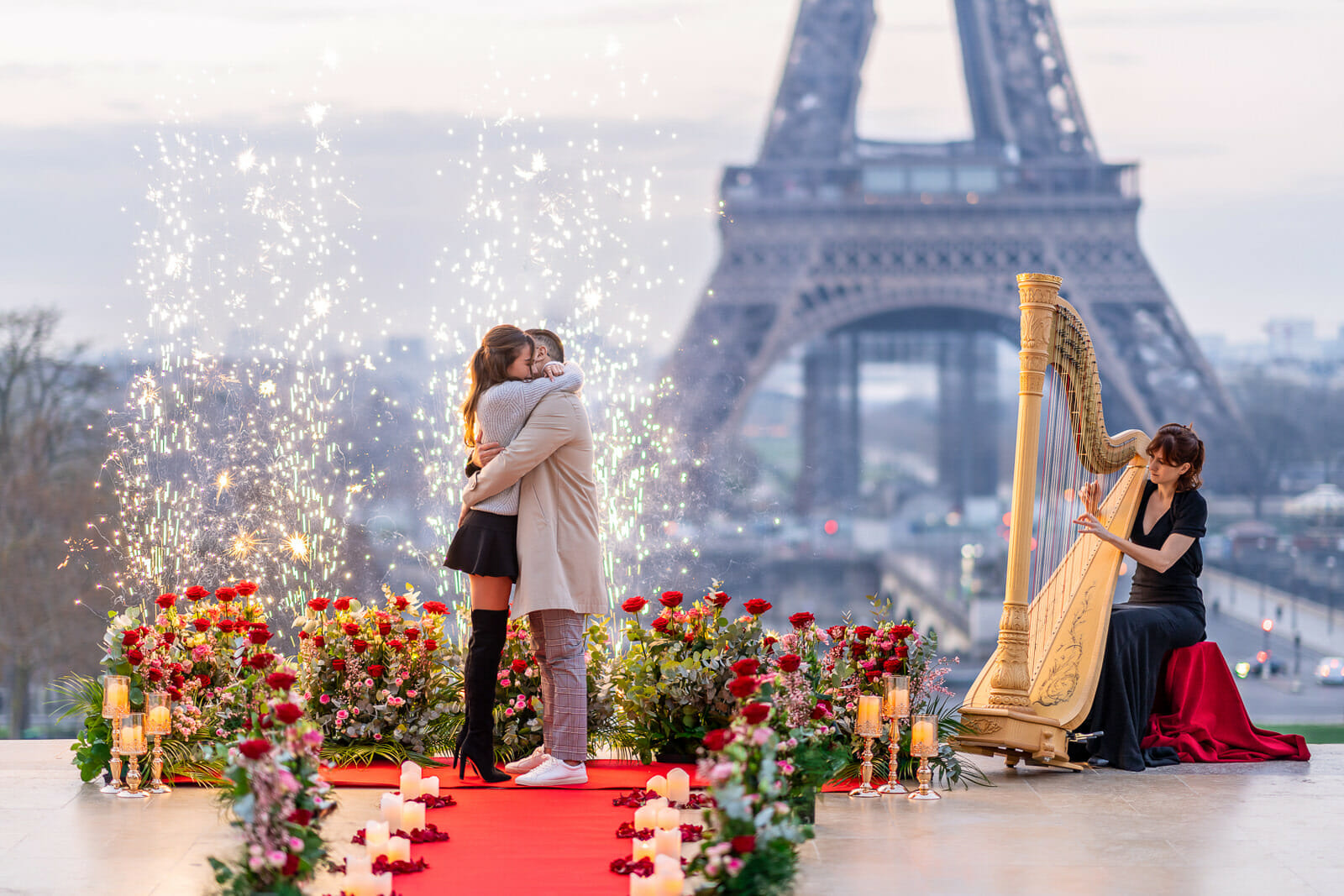
For the classic full-Tower photograph, Trocadéro is our first public choice. You get the image most people already have in mind: the two of you in front, the complete Tower rising behind. The ground is raised and the distance is right, which is why nothing else in the city quite matches it.
Trocadéro is not one position. There are six usable areas: the left platform, the right platform, the central terrace at the Palais de Chaillot, the gardens on either side, and the lower ground down toward the fountain and Pont d’Iéna. A crowd, a film shoot, or another couple in one of them does not end the plan, because the team can move.
The difficulty is the people, and the usual answer is to go early. That brings a question the location articles rarely raise, which is how you get your partner out of bed, dressed, and across Paris at that hour without making the morning before the proposal miserable. She may have flown in the day before. She may want time for her hair and makeup. She may have brought a dress and shoes specifically for these photographs. You know a photographer is waiting; she thinks you have become strangely obsessive about leaving the hotel on time.
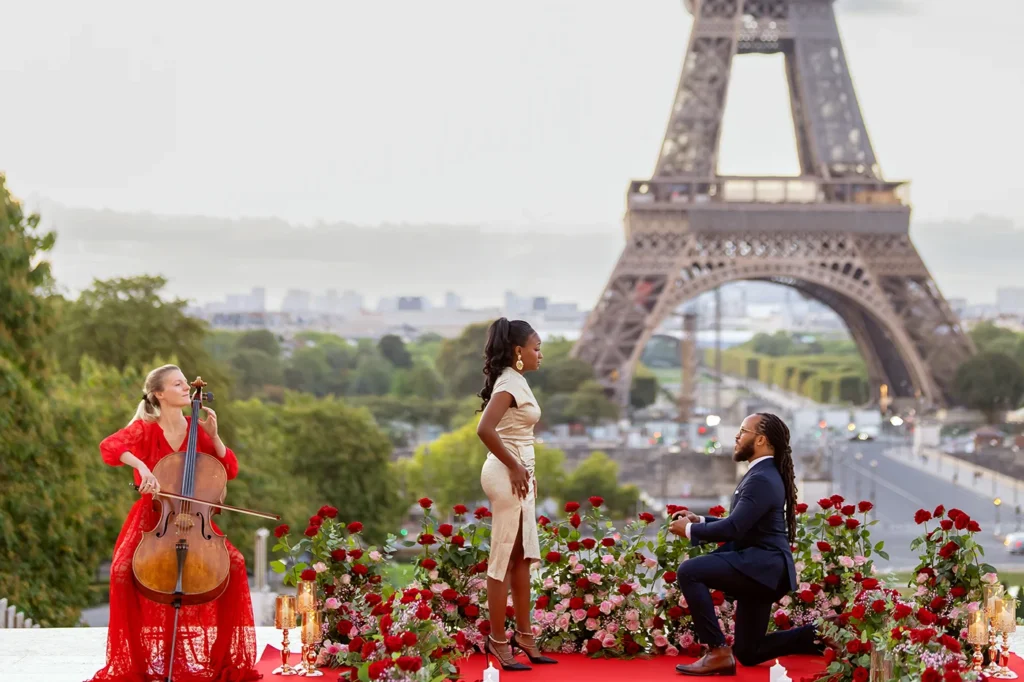
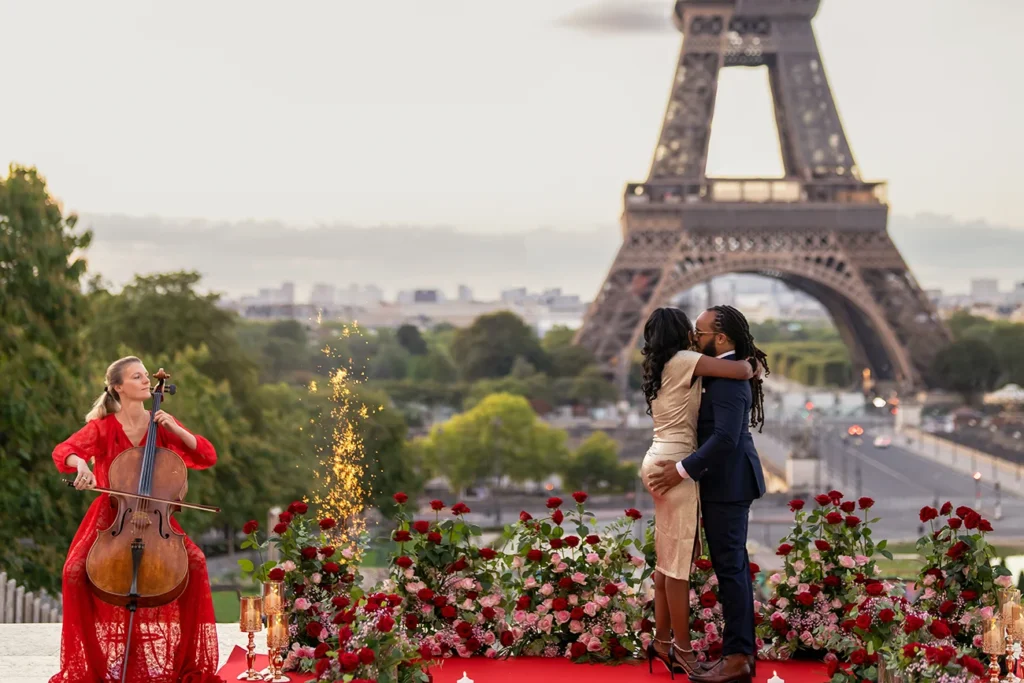
So a sunrise proposal at Trocadéro needs more than an alarm clock. It needs a credible reason to leave early and enough time for her to get ready calmly. If she arrives exhausted, underdressed, unhappy with her hair, or hurried into a car before dawn, a quieter photograph is not much of a victory. When those pieces are in place, sunrise at Trocadéro is worth the alarm clock.
Access is normally open at any hour. Temporary film shoots, demonstrations, Fashion Week production, and the cranes used to build major runway installations can block part of the site or spoil the clean Tower view even when you can still walk in.
In the evening it is a different proposition. The terrace fills, and proposing there after dark is difficult to do well.
Bir-Hakeim: bridge architecture, crowds, and partial rain cover
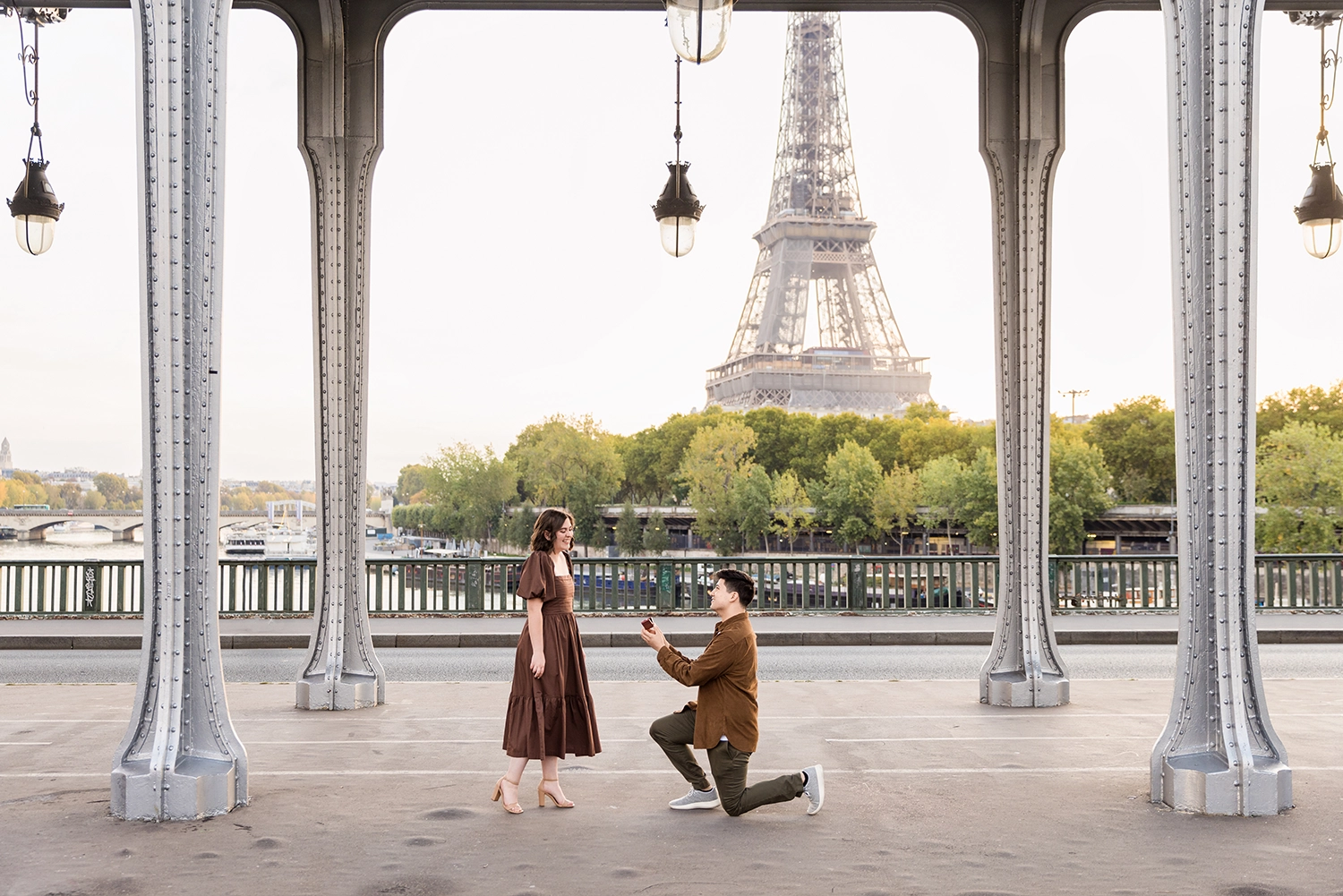
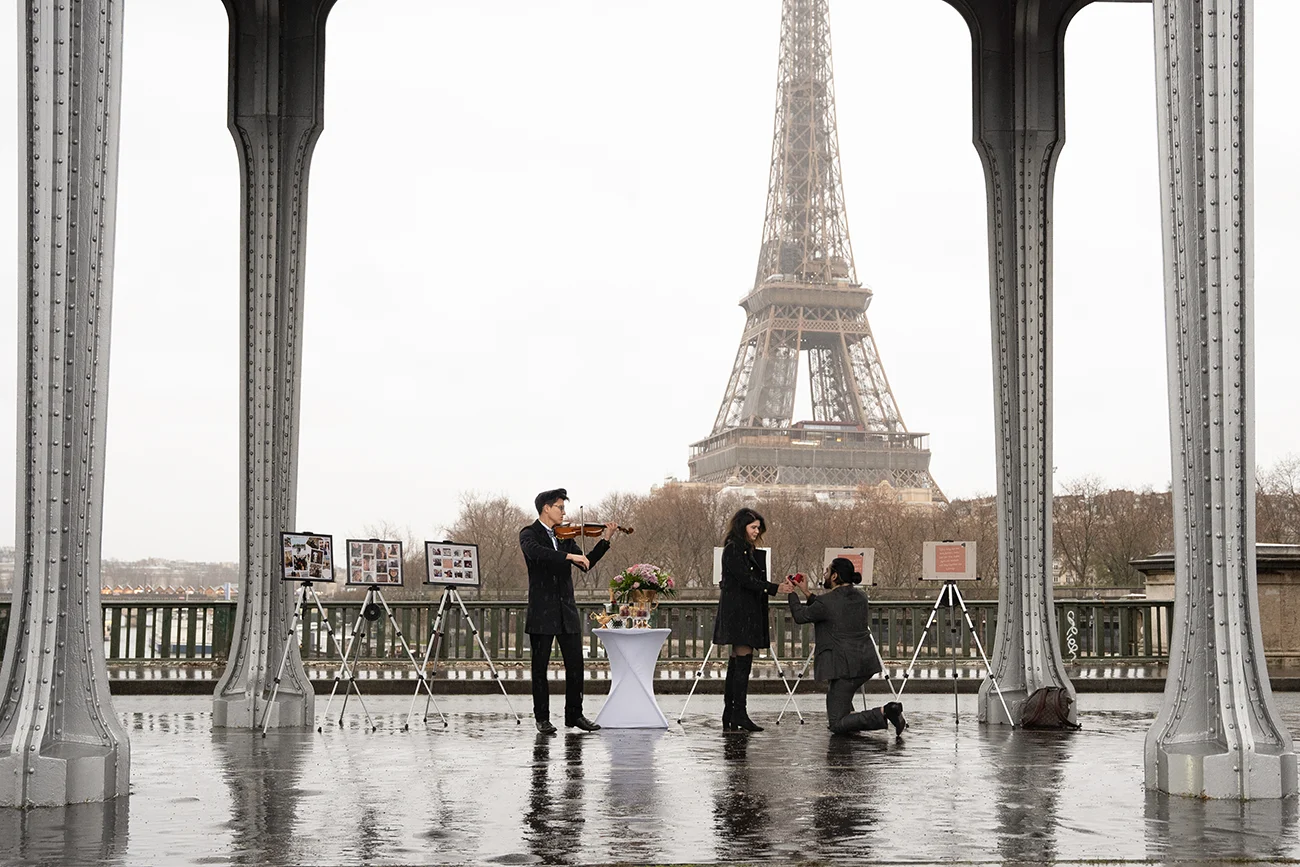
Bir-Hakeim frames the Tower through the bridge’s ironwork, and in the evening it is one of the few well-known positions where a proposal is still workable.
The two principal positions are on either side of the pier at the middle of the span. You and the Tower are generally in the same light at both, so the exposure is straightforward. The bridge lamps stay lit through most of the night, which makes Bir-Hakeim one of the few public positions that still photographs well after dark.
It is also very busy. Tourists, photo shoots, vendors, families, bachelorette parties, and a steady flow of people using the bridge as a bridge. The views are lovely if you are happy to share the space, possibly with another proposal a few meters away.
Standing under the deck puts the hanging lamps in the photograph and gives cover from rain directly above. It also puts the proposal beside foot traffic, bicycles, scooters, other photo shoots, cars on both sides, and train noise. That matters less for still photographs than for a proposal film or a speech you want recorded clearly.
Champ de Mars: grass, picnics, and a Tower that overwhelms
Champ de Mars is the one well-known position with lawn under your feet, which makes it the natural choice for a picnic proposal.
Everything is close, and you are at ground level rather than raised as you are at Trocadéro. The result is that the Tower overwhelms the couple in the photographs even when the photographer pulls back several hundred meters. When the lawn is busy, the photographs and film start to look like snapshots rather than the images you were picturing.
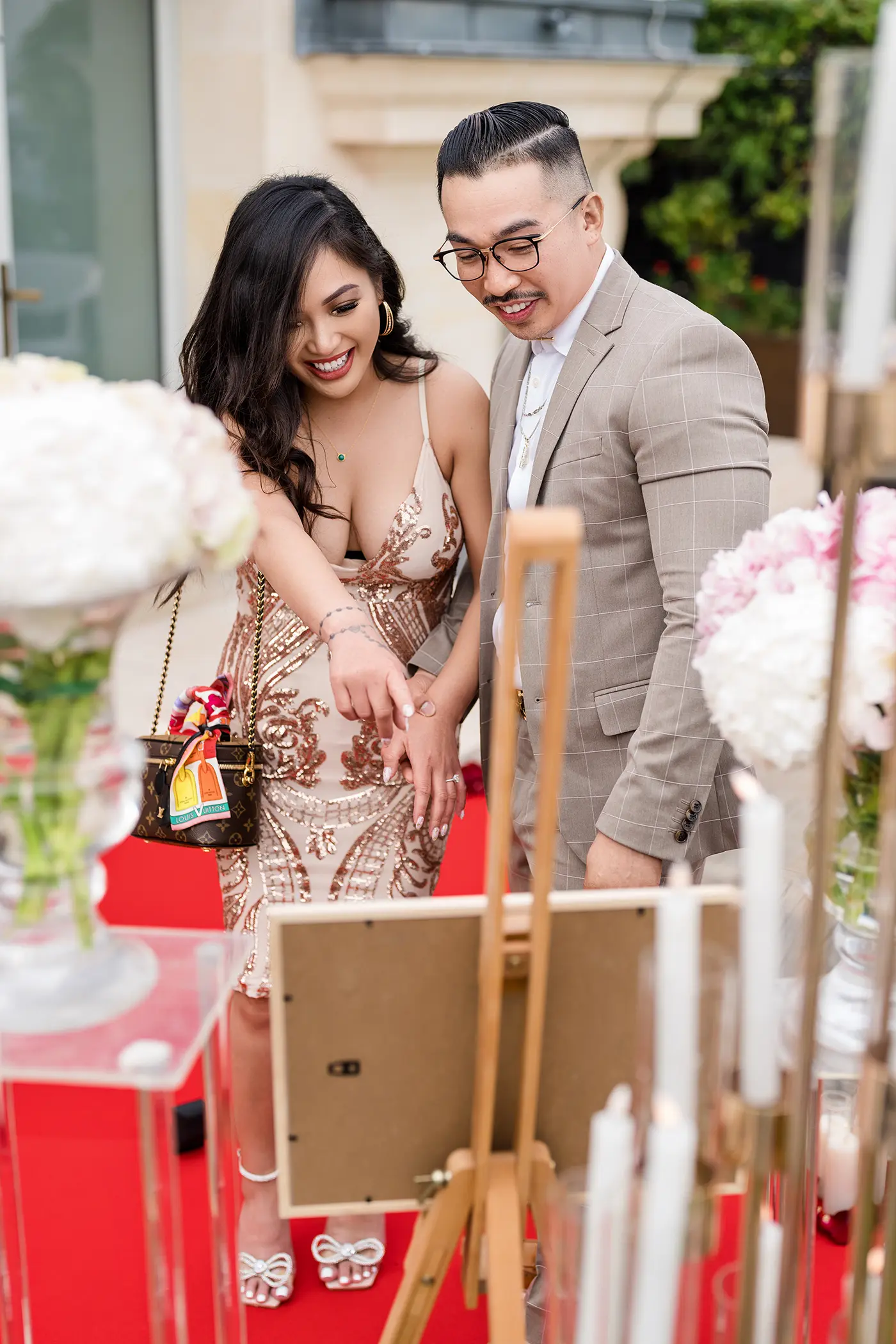
Port Debilly, below Pont d’Iéna
Port Debilly is the quay below Pont d’Iéna where couples propose. It is not the Passerelle Debilly, the footbridge farther along toward Pont Alexandre III.
This is where many of the large public setups go. On a busy evening you can see ten or fifteen similar floral hearts and illuminated signs standing within sight of one another.
It also has some of the most difficult light among the main Tower positions. The wall between the quay and the road can put the proposal area in shade while the Tower remains in full sun. A camera setting cannot make those two exposures look naturally balanced at the same time. The practical answers are a different hour, a different position, or deliberate lighting.
The photographer has very little room to retreat. To fit the complete Tower from that distance, something around 24mm may be needed for a vertical frame. That focal length does its job, but it exaggerates perspective at close distance and is less flattering for the couple. It also leaves much less room for a balanced horizontal film composition. The approach is cobbled.
Access for delivery vans has become more restricted, which makes setup and clearing away slower and more labor-intensive. A picnic, a champagne table, or the two of you alone often suit this quay better than a large installation, and a discreet proposal attracts less scrutiny than a visible commercial production.
Passerelle Debilly: architecture, and a good place for a surprise
Passerelle Debilly is the footbridge farther along toward Pont Alexandre III. It is not Port Debilly, the quay below Pont d’Iéna.
Debilly is a footbridge with unusual architecture, and we use it more often for the surprise before the proposal than for the proposal itself. A pantomime artist, a magician, or a musician the two of you appear to come across on the walk.
A proposal there is possible. At the position we use, nobody can pass behind you, because there is nothing behind you but the river. The ironwork does cut across the Tower, and the deck is narrow enough that people walk through a setup or step over its edge, so it is not the place for anything large.
Avenue de Camoëns: a residential street with a postcard view
There are two usable positions: street level, and the steps down toward Boulevard Delessert.
The light is among the hardest on this page. The buildings can shade the couple while the Tower stays several stops brighter, and the small standing area gives the photographer less room to solve the problem by changing position. Everyone there shares the same small area, so open access does not mean privacy.
The street sign and the trash cans are part of the frame. A still photograph can be retouched. Removing the same objects from an entire film is much harder.
Pont Alexandre III
Choose Pont Alexandre III for the bridge, the gilded lamps, and the Seine, with the Eiffel Tower present but secondary.
Traffic on both sides limits how far the photographer can step back, so the Tower reads smaller here than at Trocadéro, Bir-Hakeim, or Port Debilly. The same traffic affects sound, which matters for film and for a speech.
There is one attractive position at the top of the stairs down to the Port des Champs-Élysées. It works until a runner comes up the steps or a pedestrian walks between the couple and the photographer, which is why the timing and camera direction are agreed before you arrive.
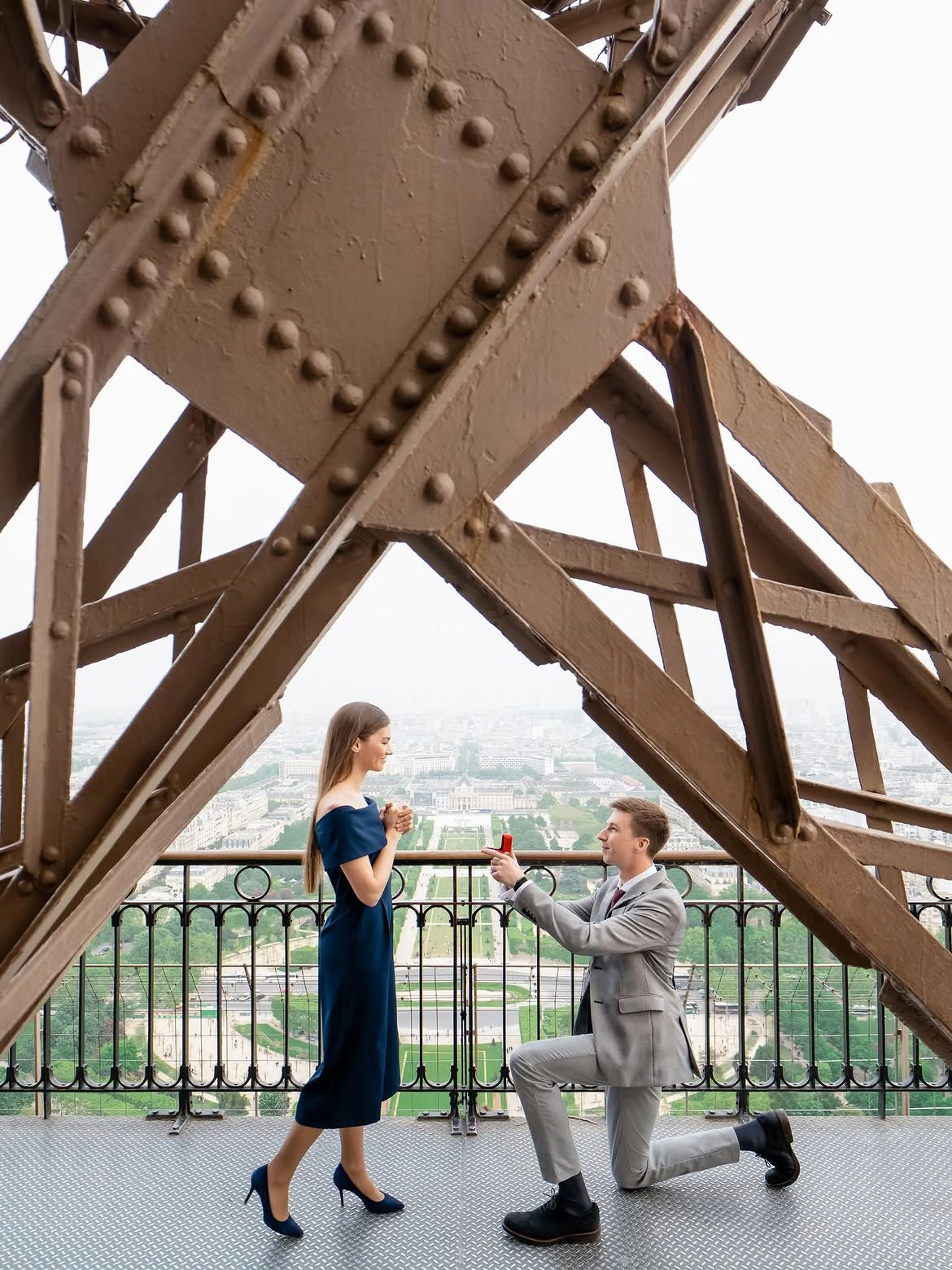
Can you propose on the Eiffel Tower itself?
Yes. You can buy tickets and propose while visiting the monument. The better question is whether that gives you the proposal you had in mind.
The Tower is a ticketed public attraction. You share the visit with everyone else who booked that slot, pass through its normal access and security procedures, and control nothing simply because you intend to propose. There is no reserved corner, nothing prepared before you arrive, and a photographer buys a ticket and stands where the public stands.
Photography is the deciding argument. If you are standing on the Eiffel Tower, the Eiffel Tower cannot be behind you. Your photographs show the structure around you and Paris below, rather than the silhouette everyone recognizes. If being on the Tower matters more to you than having it in the picture, propose there confidently. If the reason you chose an Eiffel Tower proposal is the image of the two of you with the landmark behind you, ask somewhere the camera has enough distance to see it, and go up afterward with the ring already on her hand.
How much does a private Eiffel Tower proposal cost?
Private Eiffel Tower proposals start at €1,600 for a small boat on the Seine and €2,000 for a residential rooftop. The terrace we recommend most often starts at €2,400. Palace hotels, larger yachts, extra guests, dinner, film, and fresh floral production cost more than that, and those numbers are in the cost guide.
Privacy does not begin at Palace-hotel prices.
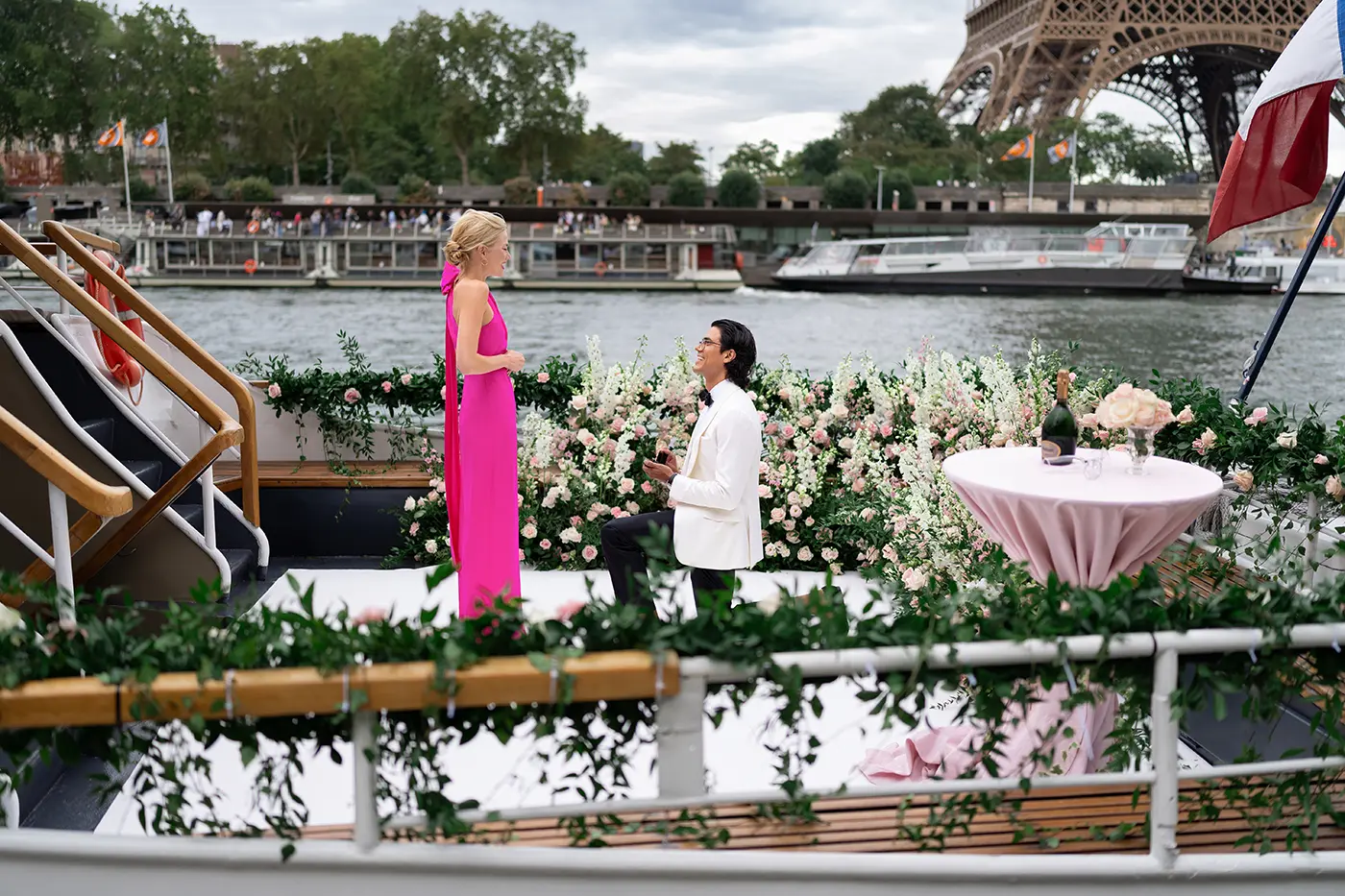
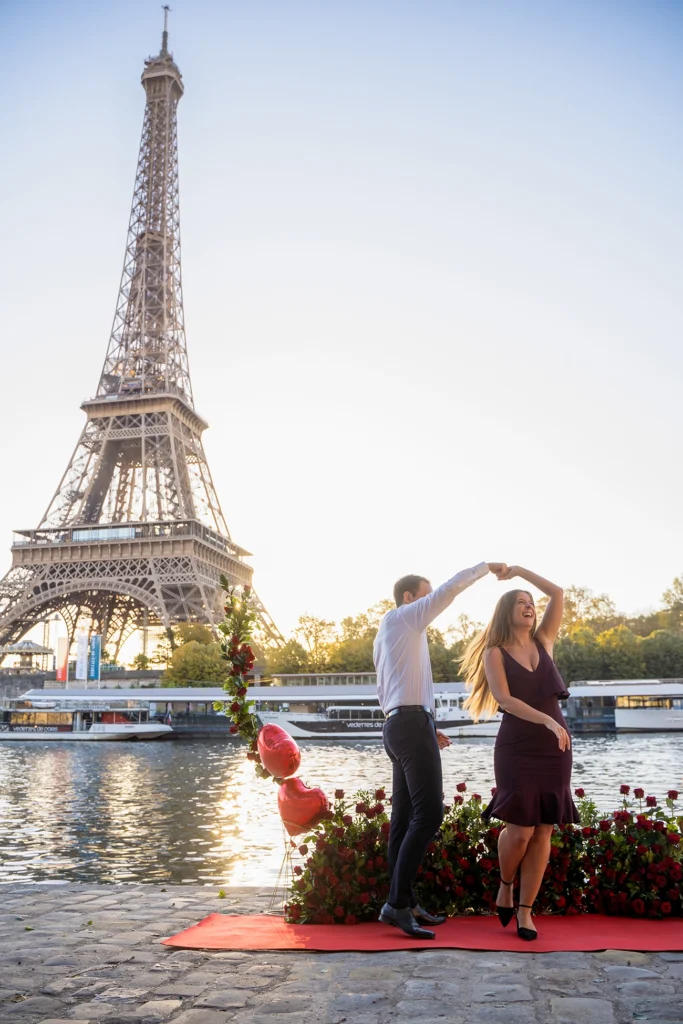
A private boat on the Seine — €1,600
The package is €1,600 and includes the boat, a simple silk floral design along the railing, and professional photography.
For the proposal itself you have a private setting with the Eiffel Tower behind you and no other guests aboard. After she says yes you are already on the Seine, so instead of packing up beside a public riverbank and looking for a car, you continue through Paris and see the city from the water as an engaged couple. It is not a large yacht production, which is why the price is what it is.
For a man who wants the Tower, professional photographs, privacy, and a prepared setting without spending several thousand euros, this belongs in the comparison before he books a heavily decorated public proposal.
A residential Eiffel Tower rooftop — from €2,000
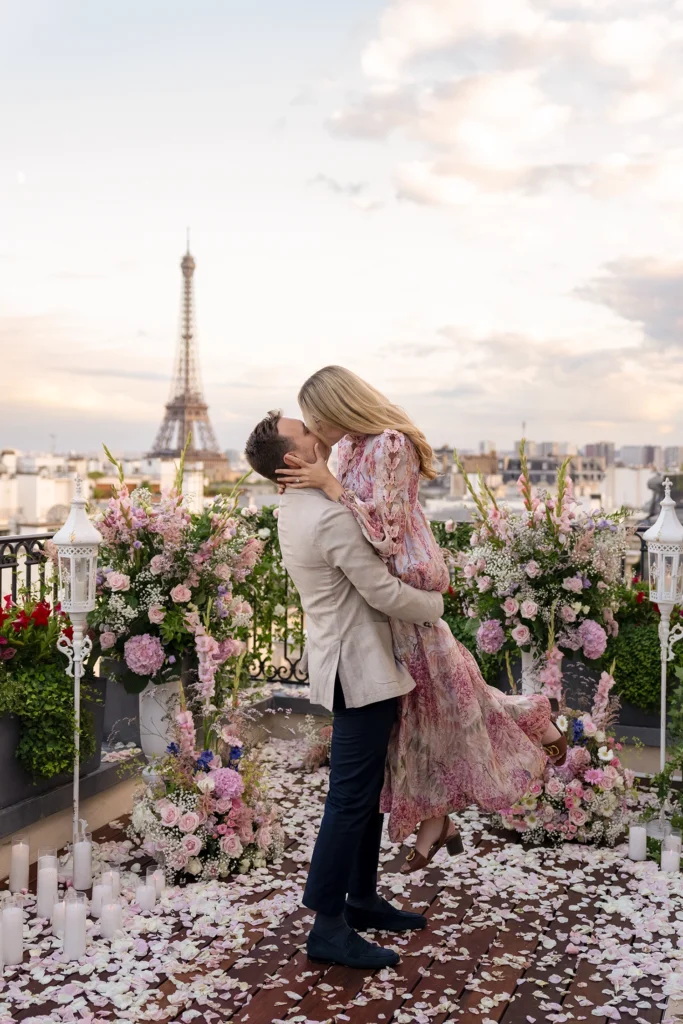
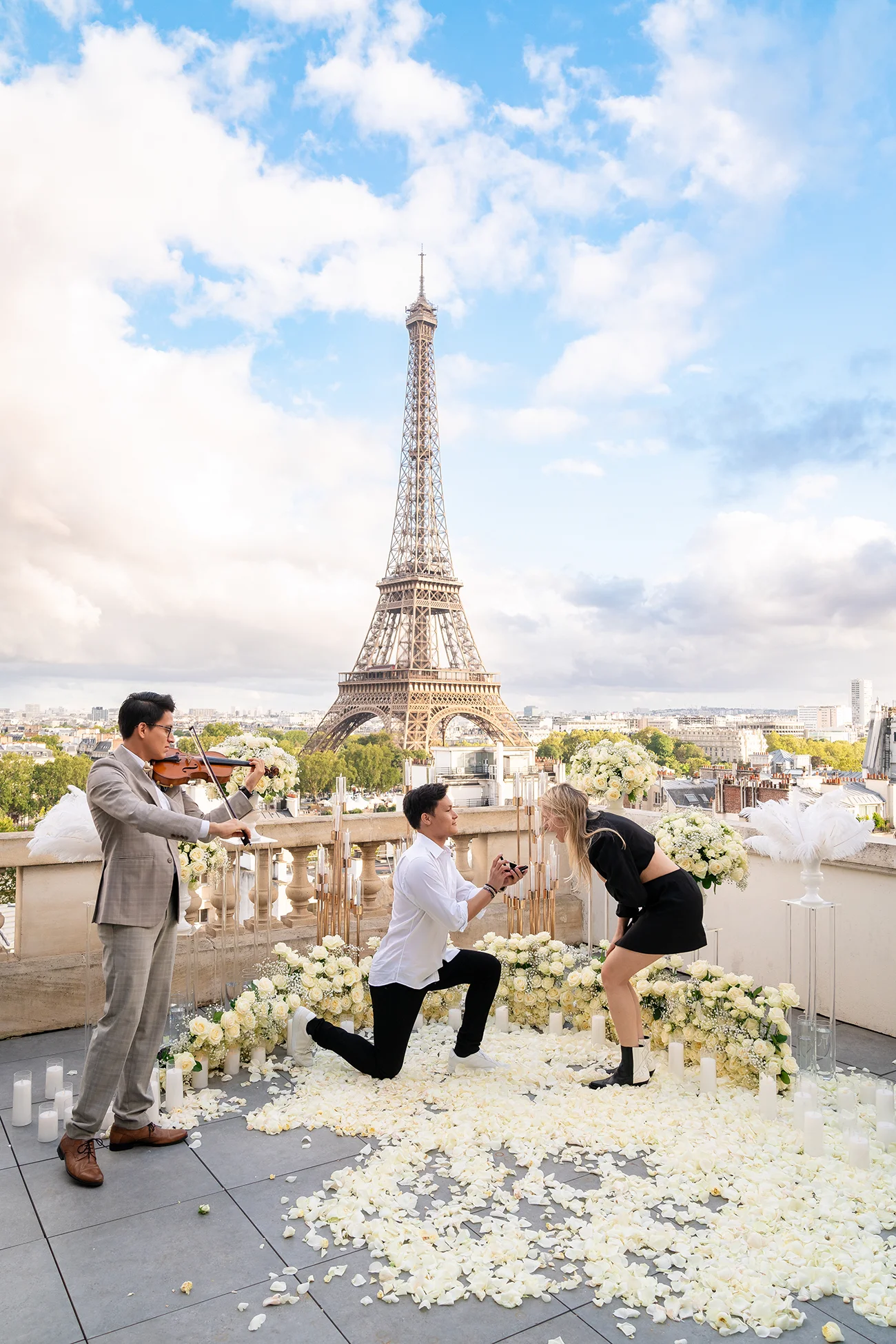
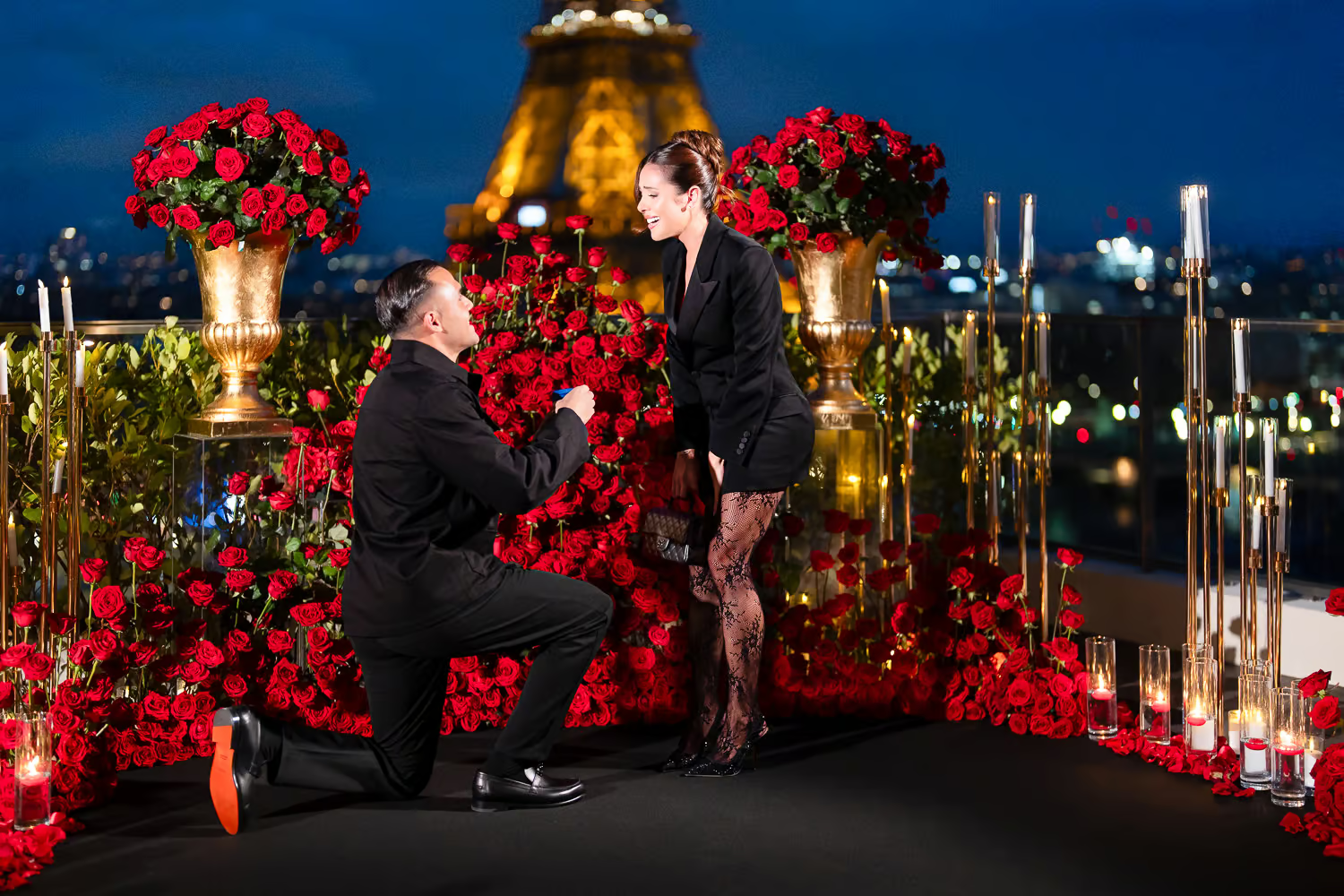
Residential rooftop proposals start at €2,000, including a full silk floral setting and professional photography on a private terrace with the Tower in view.
The terrace we recommend most often starts at €2,400. That includes the terrace, a red carpet setting with silk florals, and photography, and it is the one we point people toward when they ask which we would choose ourselves.
Both are ready-to-propose packages, which means the look is proven and popular rather than designed from nothing for each couple. The materials are not. Carpet, florals, and petals are prepared for your booking rather than recycled through high-volume public setups.
The terrace is private for the agreed access period, and the photographer works around a known position rather than around whoever happens to be standing in it. For clients weighing a large public setup against private access, this is the comparison worth making.
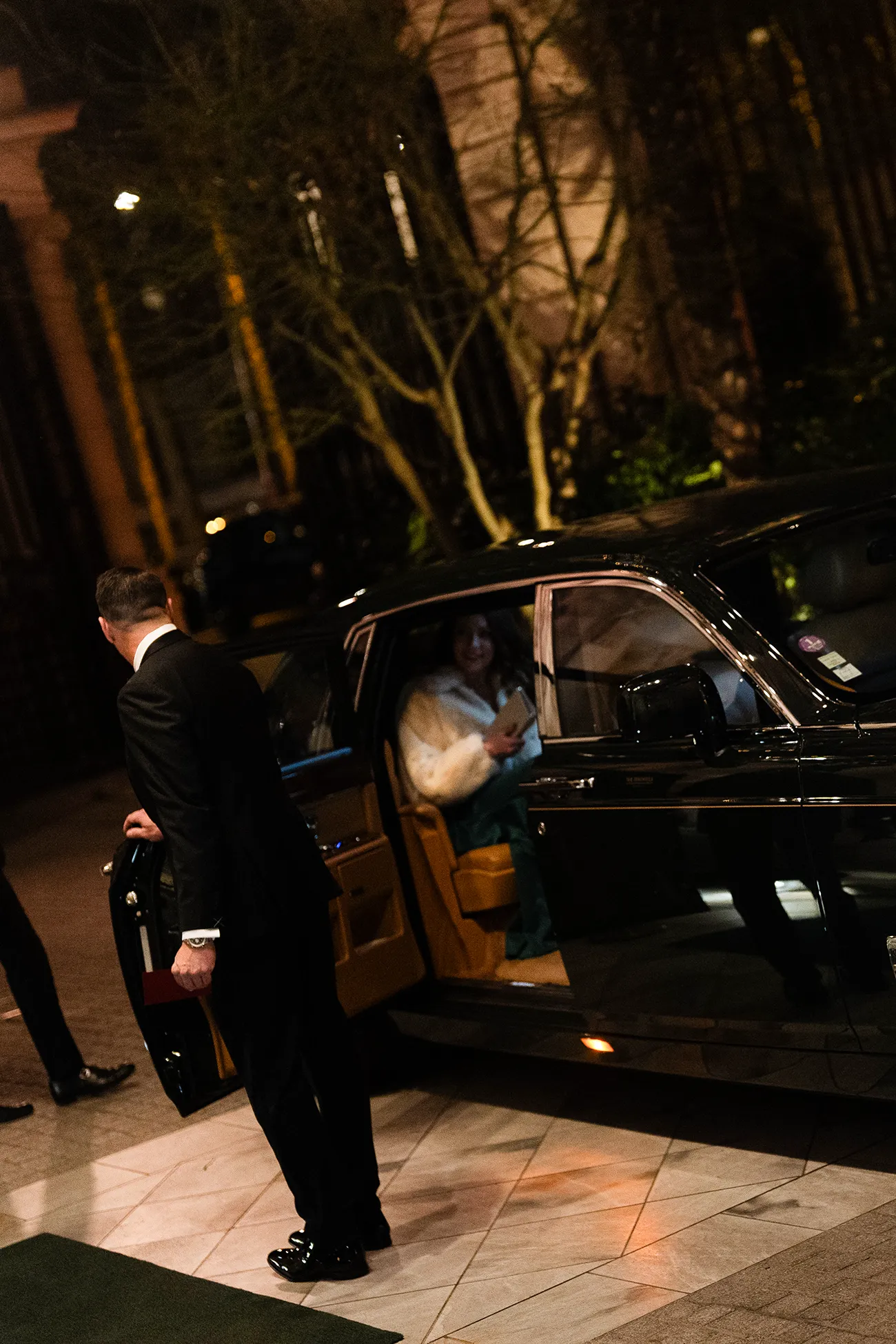
What couples add to a rooftop proposal
After a rooftop proposal you are going to dinner, so transport is usually the first addition, from a V-Class up to a Rolls-Royce when the drive should be part of the celebration rather than the gap between two parts of it.
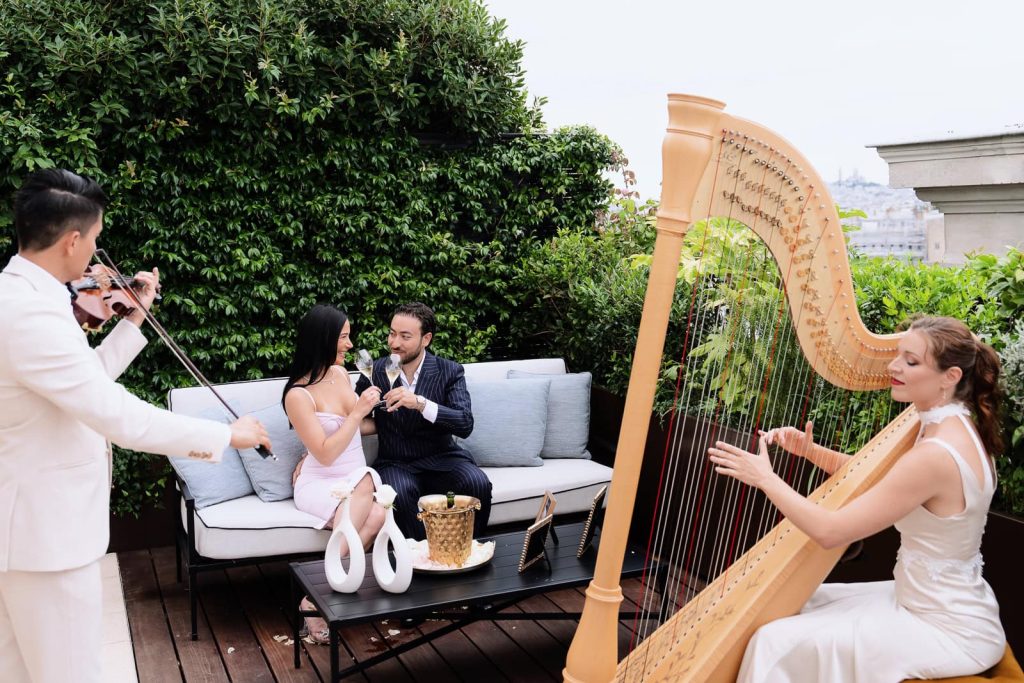
After that, in rough order of how often they are chosen: Champagne on the terrace, film alongside the photography, a musician, and the hotel room prepared while the two of you are out at dinner. Each is priced on its own, so the package stays what it says it is and the evening grows only where you want it to.
Before you pay for a large public setup, price the private one
A public location has no venue fee. That does not make the proposal free.
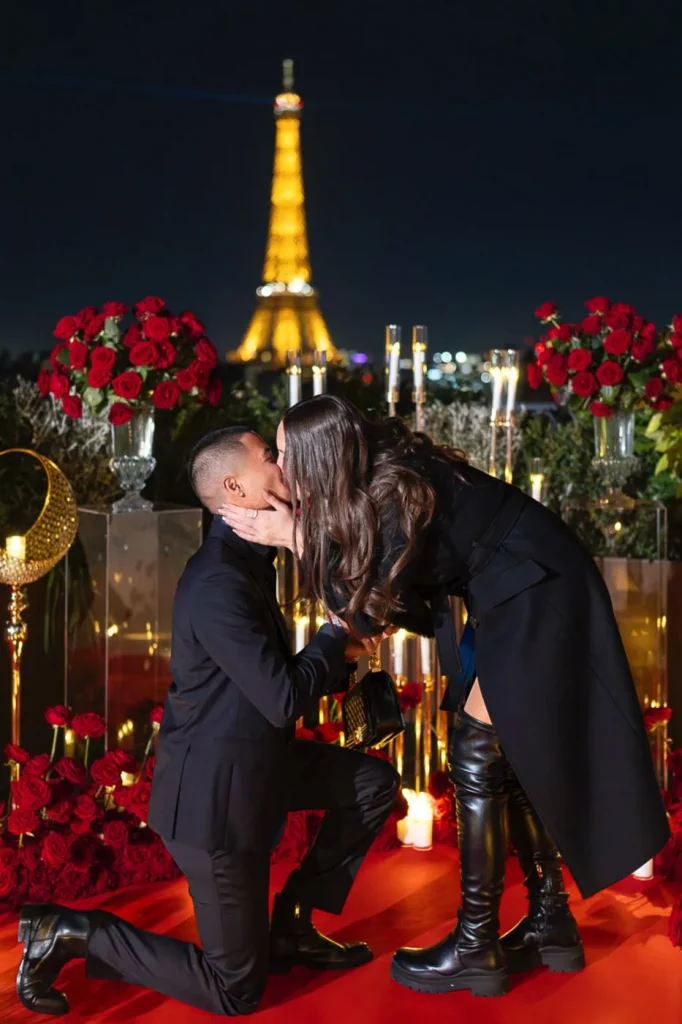
Add a floral heart or letters, flowers, photography, film, a musician, lighting after dark, transport, installation, removal, and coordination, and you can spend a considerable sum while the setting around your décor stays open to everybody else. If your partner would adore the letters, the cheering strangers, and the energy of proposing beside the Seine, spend the money there and do it well. A simple public proposal with an excellent photographer will also remain the least expensive route, and for many couples it is the right one.
But once the public proposal becomes a production, compare the finished price against €1,600 for the private boat and €2,000 for the residential rooftop. The gap is often small.
What kinds of private Eiffel Tower proposals are there?
Private describes several ways of reserving control, not one product, and a residential rooftop, a hotel terrace, a suite, and a yacht solve different problems.
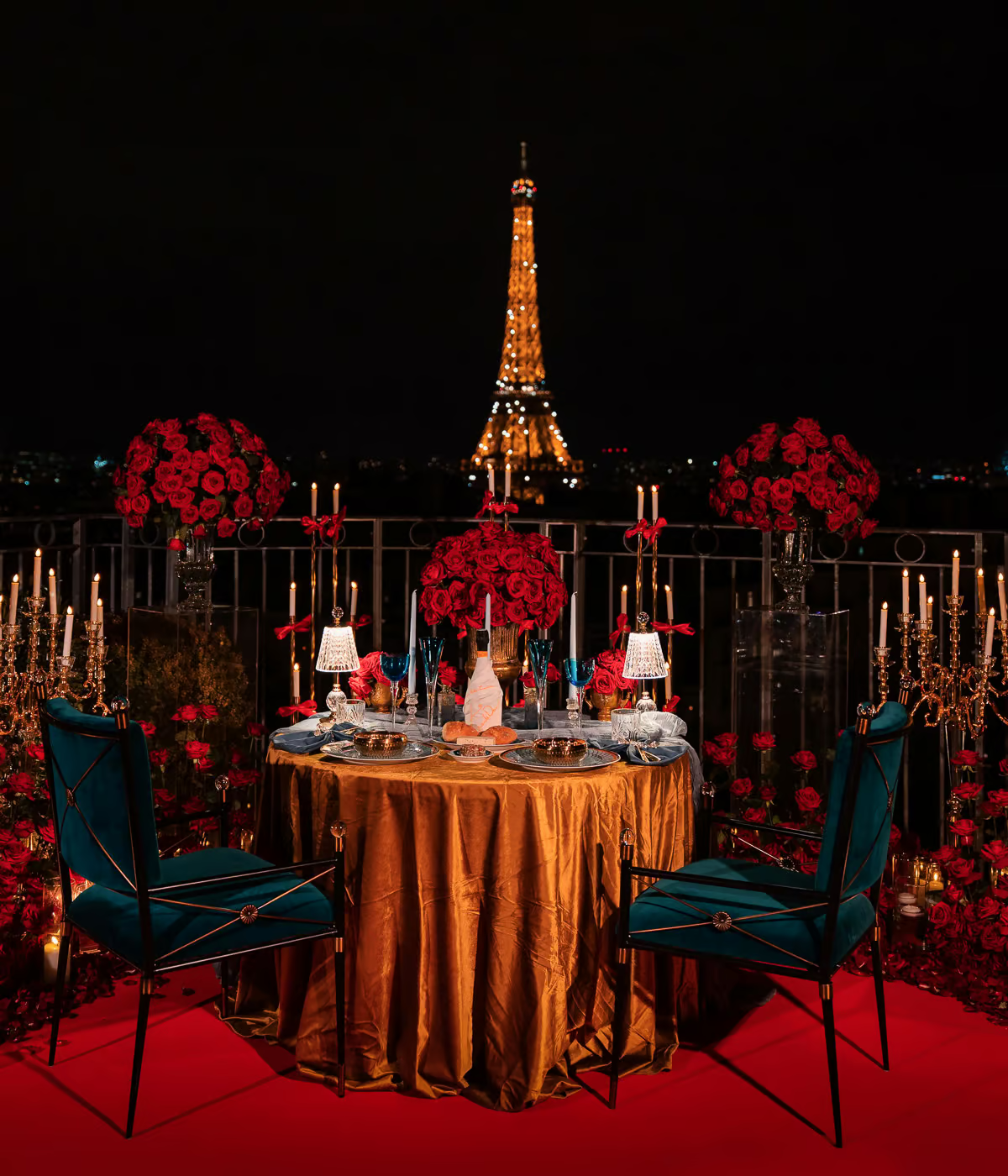
Residential rooftop: private access without an overnight hotel
A residential rooftop gives you a private view and a prepared setting without booking a Palace-hotel suite for the night. That suits a man who cares about privacy and photographs but already has a hotel, or who would rather not spend a large part of the proposal budget on a room.
Judge each terrace on its own. Elevator access, stairs, neighbors, music, guest numbers, vendor access, installation time, wind, furniture, dinner, and what happens in poor weather all differ. One terrace will take a substantial setup. Another, just as beautiful in photographs, is a poor production space because access is difficult or the building restricts what can happen up there. The photograph will not tell you which is which.
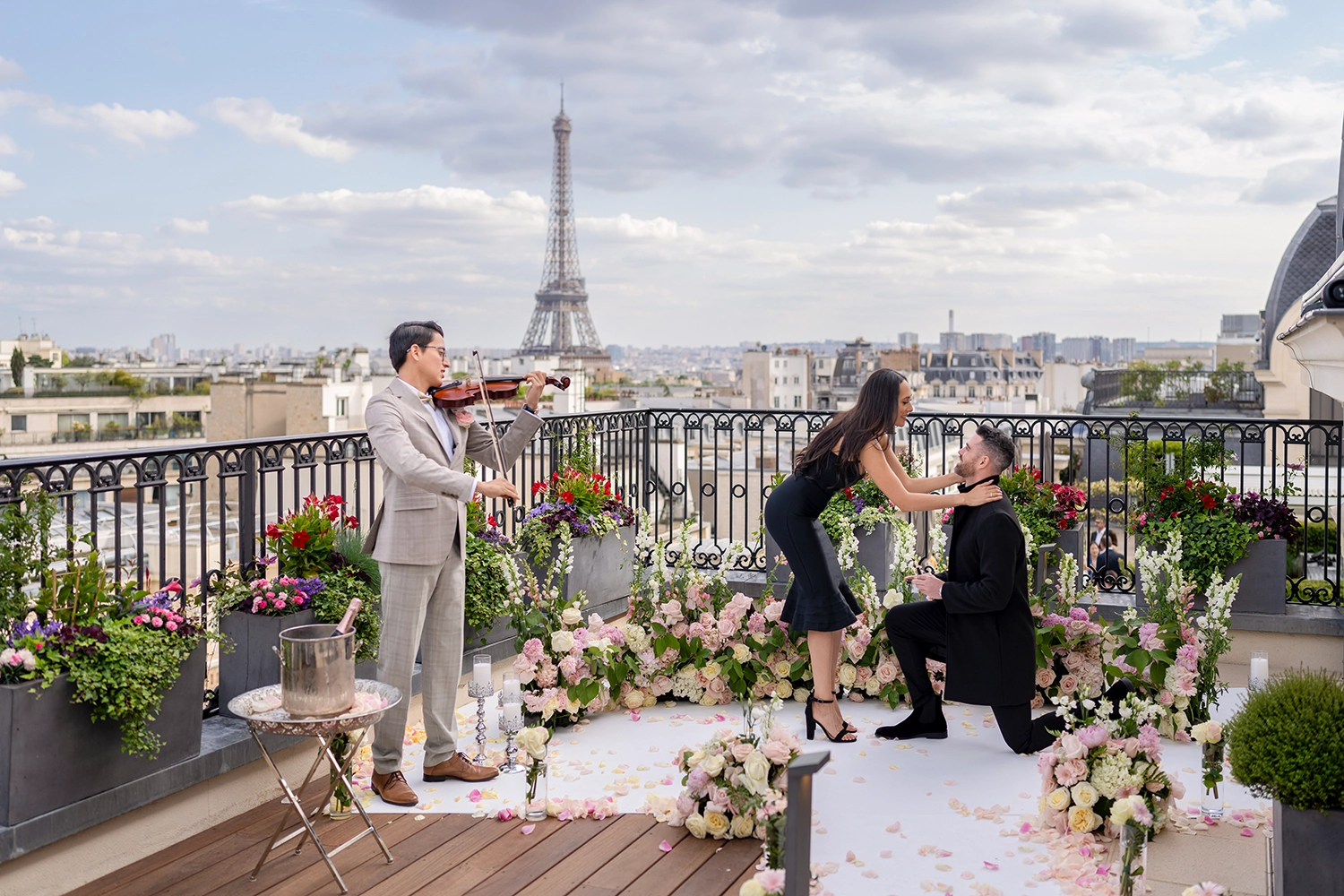
A terrace reserved for a time slot
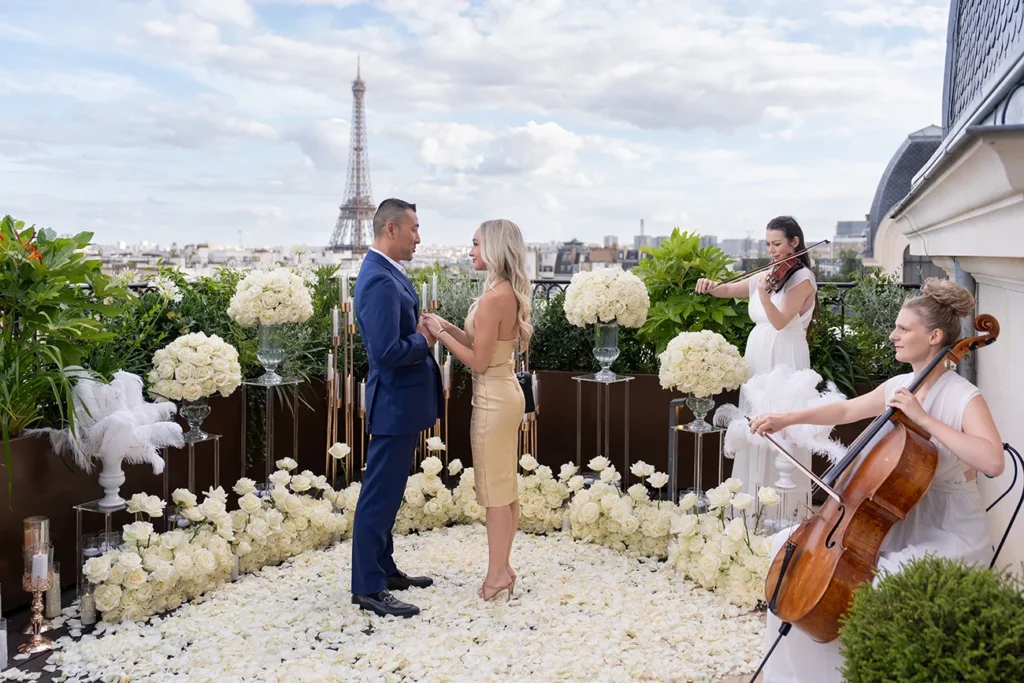
A hotel or venue terrace can sometimes be reserved for a defined period without an overnight room. The Peninsula’s Secret Table is one example. You reserve private access for the agreed period, use the terrace for the proposal and whatever else the booking allows, and sleep wherever you like.
It works particularly well when you want a Palace-hotel setting for the proposal but already have another hotel in Paris. The questions are practical: how long do you have, when can the team enter, how many people are allowed, what can be installed, whether musicians are permitted, what happens in rain, and whether dinner can follow.
Money does not solve the light. At certain hours the terrace itself falls into shade while the Tower behind it is still in full sun, and that happens at the best addresses in the city, the Secret Table included. It is a scheduling question worth asking before you book.
We have had vendors turned away at addresses like this one, which is why the team and the access plan are agreed with the property before anything is promised to you.
An Eiffel-facing room or suite
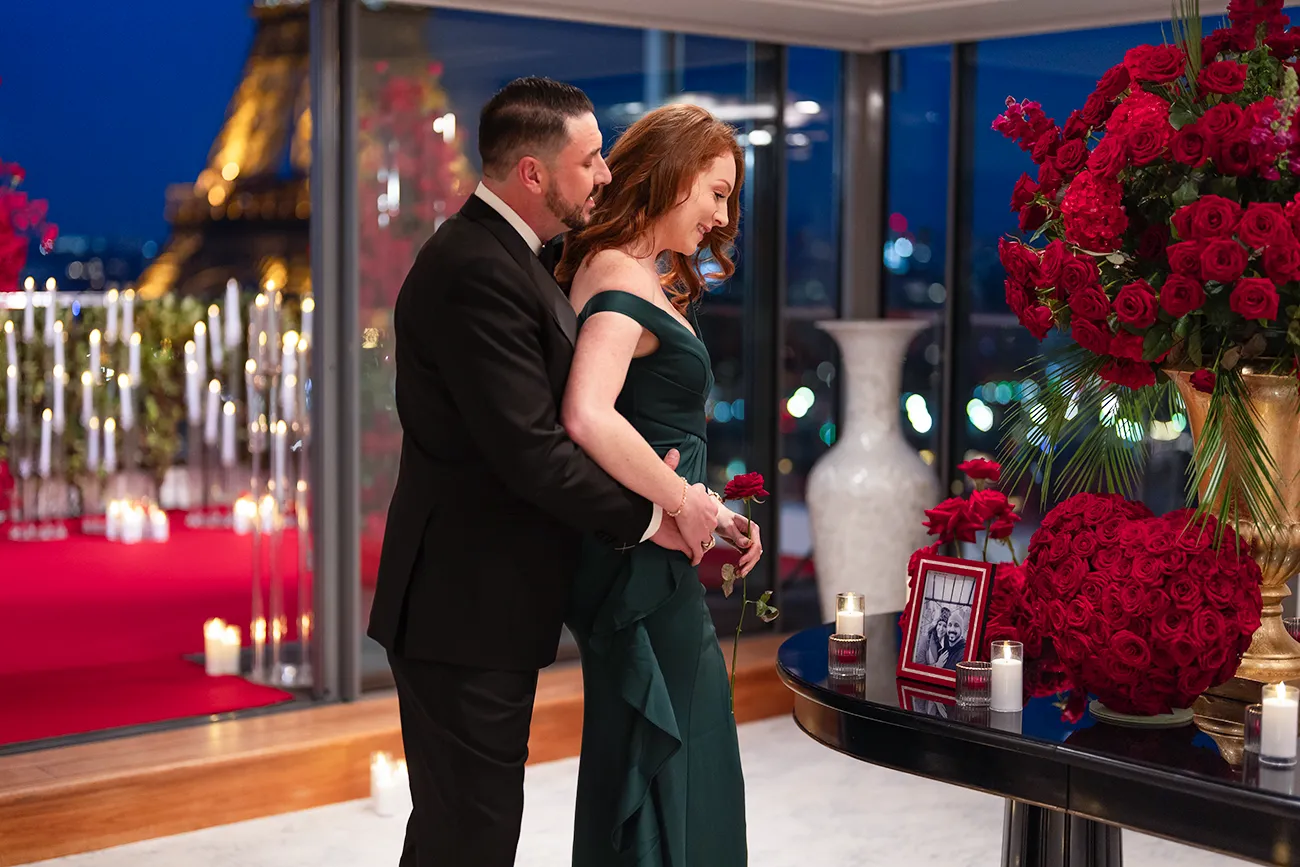
A room or suite changes the whole day, because you keep it through the night. At the right property and in the right room category, the proposal, your first meal as fiancés, and your first night engaged can all happen at one address without a car between them.
At Shangri-La Paris the categories worth knowing are the Duplex Terrace Eiffel View Suite, La Suite Shangri-La, and the Paris Panoramic Signature Room. At the Peninsula it is the Rooftop Garden Suite. A few other categories at these addresses face the Tower and are less useful for a proposal, and which one fits your plan is worth a conversation before you book.
Book the room category, not the hotel name. “Eiffel Tower view” can mean a partial view through a window, a bedroom facing the Tower, a salon facing it, or a large private terrace, and those are four different proposals. Confirm the view from the exact category you are reserving, then confirm terrace access, guest limits, vendor entry, florals, photography and film, dinner, and the weather alternative. A hotel’s reputation does not answer any of those.
A private Seine yacht
A larger yacht makes the Seine more than a place to ask. The vessel can hold its position while you propose so the Tower is where you want it, family may wait elsewhere aboard depending on the vessel, and dinner, musicians, florals, photography, and film can be prepared on deck.
That might be a proposal for two followed by dinner. It might be both families hidden one deck away, appearing seconds after she says yes. It might be a private City of Lights cruise, dinner, dancing, and a car waiting at the dock. A €1,600 boat and a multi-deck yacht are both on the Seine and they are not the same purchase.
Compare Paris rooftop proposals · See a private Seine yacht proposal
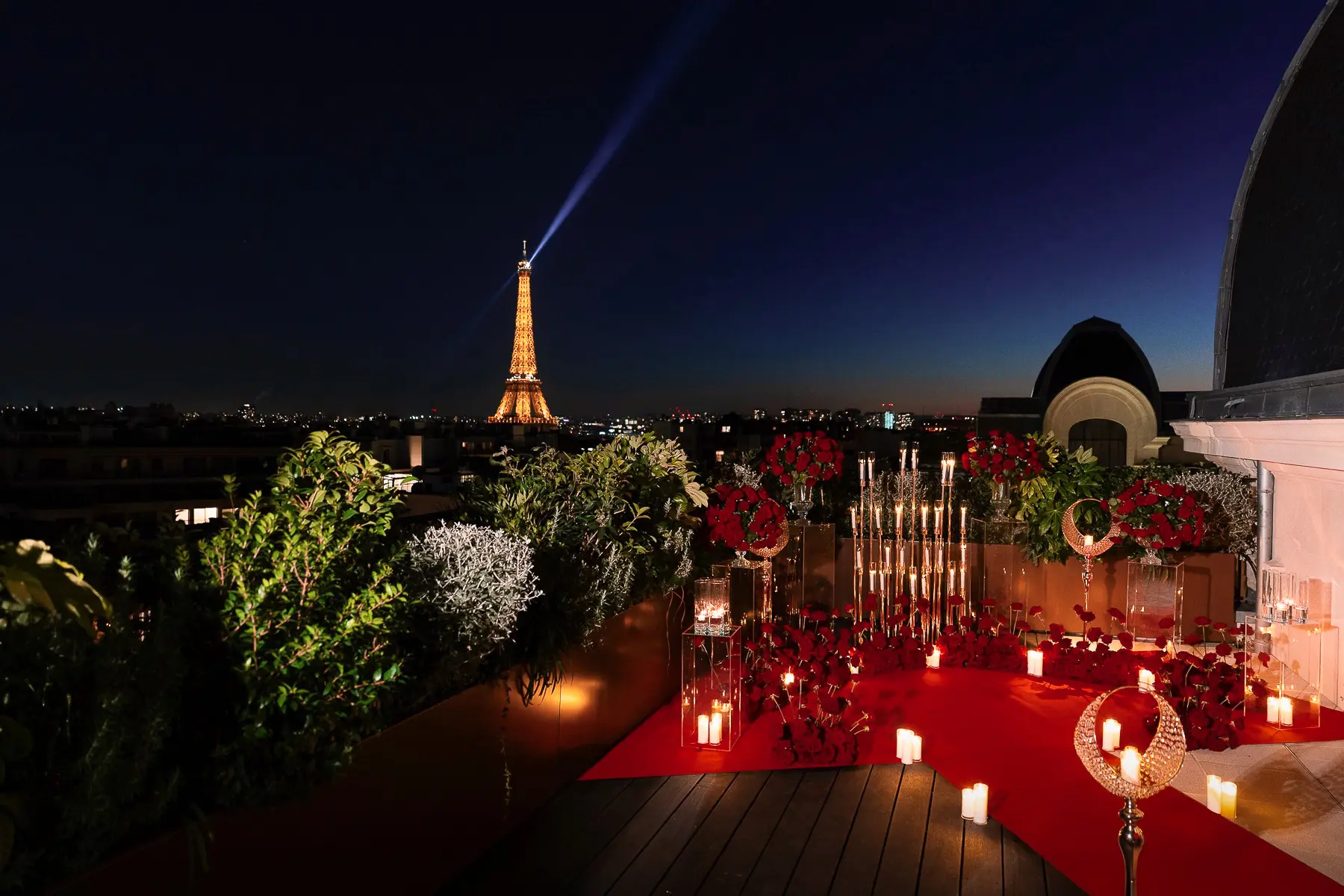
How will the Eiffel Tower look in your proposal photographs?
Distance and focal length decide how large the Tower looks. Closer is not better.
Standing directly beneath the Tower does not give you more of it. It gives you two people the size of ants at the base of something enormous, with the top of the structure cropped off. The same logic catches couples who choose a hotel for proximity to the Tower rather than the view of it. The Pullman Paris Tour Eiffel stands almost at the foot of it, and some rooms do face the Tower. Proximity by itself still does not tell you the angle or the scale the Tower will have in your photograph.
Move back and the whole silhouette fits behind two people who are still recognizable. Move too far and the Tower shrinks into the skyline behind you.
Then there is the lens. From the same position, a wider focal length makes the Tower smaller in the frame and, past a certain point, makes faces less flattering. A longer focal length makes the Tower larger, until it feels as though it is standing directly behind you. What limits that is the room the setting gives the photographer, because a longer focal length needs him to stand farther back. Fifty millimeters is often the practical ceiling on a terrace, and some will only take thirty-five or less.
The clearest example is Port Debilly. Pressed close to the Tower with a wall behind him, the photographer may need something around 24mm to fit the whole structure into a vertical frame. That lens can do the job, but at that distance it exaggerates perspective and is less flattering for faces. It also leaves much less room for a balanced horizontal film composition.
You do not need a view on lens choice. You need to know that how far away you stand, and what the photographer can shoot from where he is standing, are the two things deciding how large the Tower will be.
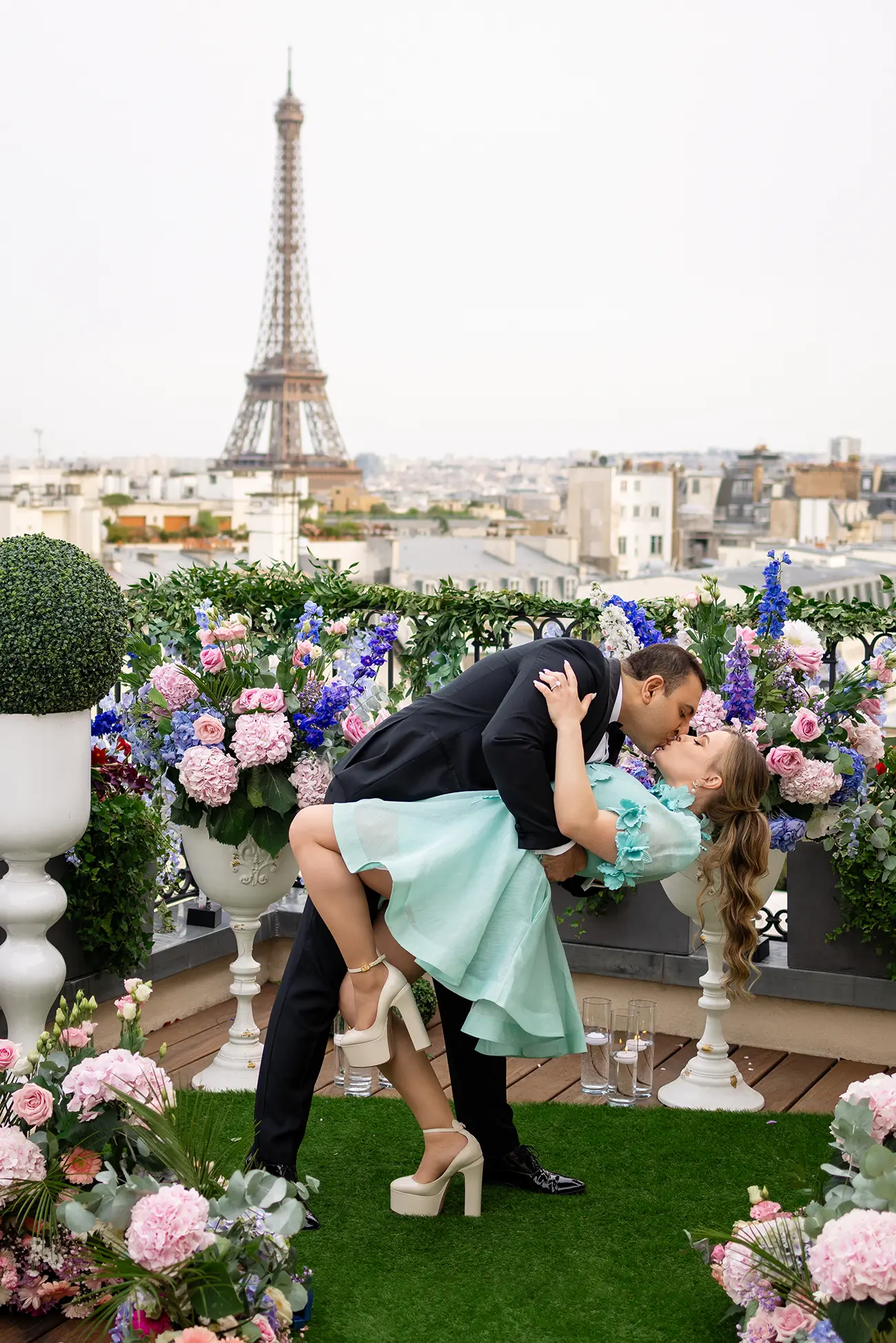
Among private settings, some of the most intimate Eiffel Tower views are from a Tower-facing suite terrace at Shangri-La. The view is only one part of choosing the setting. Budget, date, headcount, usable space, the cover story, dinner, weather, and where you spend the night can all change the answer.
| What you want to see | Where it comes from | What changes |
| The Tower filling the frame | Directly beneath it | Dramatic scale, and the two of you are very small |
| The complete Tower behind you | Across the river, at distance | The classic composition. Needs camera distance |
| Tower, setting, and city together | A private terrace | Florals, table, and rooftops share the frame |
| The Tower across the water | A boat or the riverbank | Reflection, movement, and a changing angle |
| The Tower through an interior | A room or suite | Windows, reflections, and room light decide it |
| The Tower sparkling at night | Any Eiffel-facing position | Light the couple, not just the landmark |
Give the photographer room
If you want the complete Tower visible behind two people, the photographer needs physical distance. That applies to public positions, rooftops, hotel terraces, and yachts alike.
A terrace can look enormous in an empty photograph and feel very small once you add two people, flowers, a musician, a dinner table, and a photographer and filmmaker who both need space to step back. The same is true of a hotel room. Do not judge a proposal setting from a picture taken in the doorway with nobody in it.
Think about the ring hand before you arrive
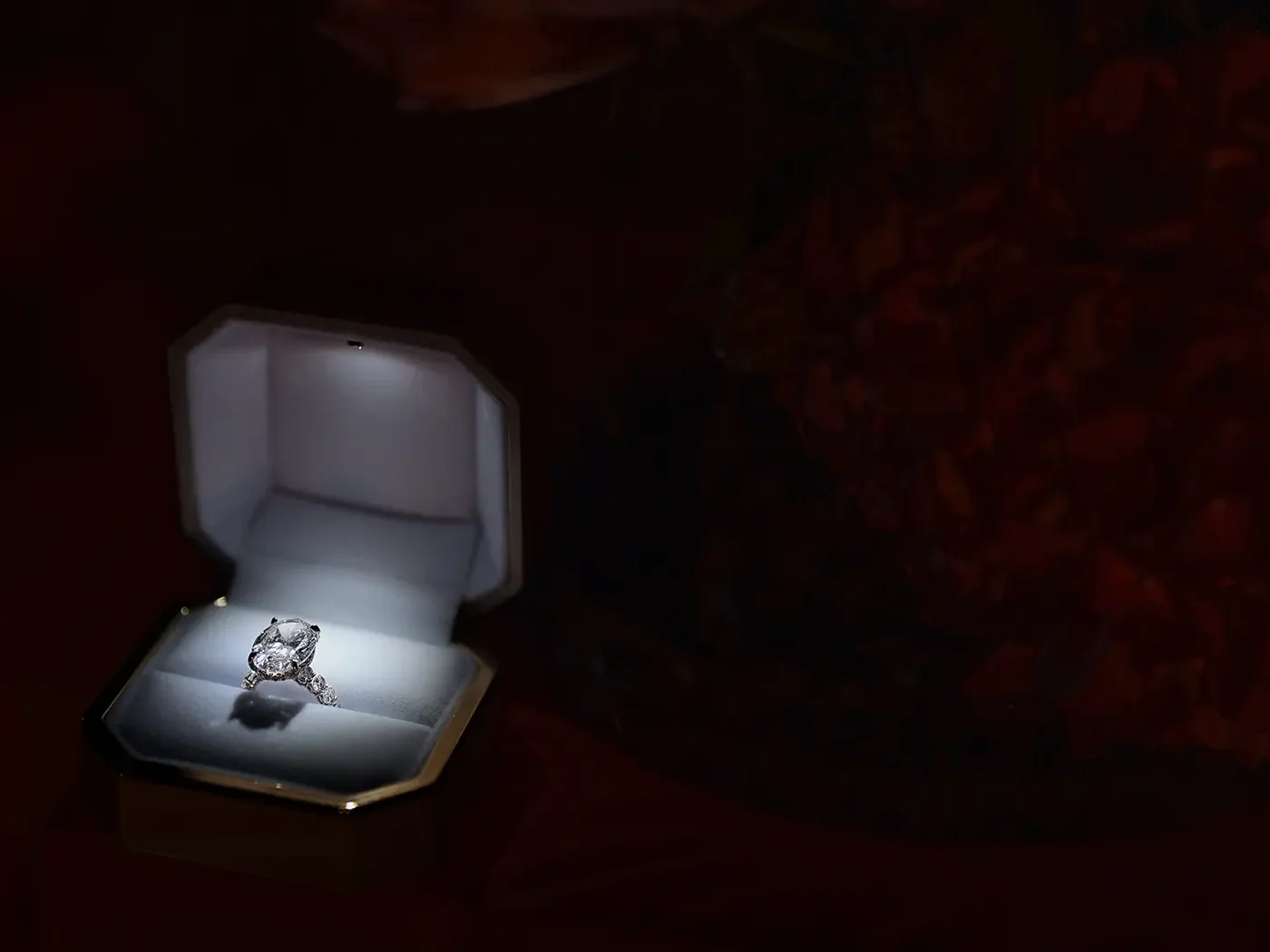
When we position an Eiffel Tower proposal, we plan the ring exchange as well as the photograph. Where the setting allows it, we position the couple so that her left hand stays open toward the photographer as you put the ring on it, which gives you the best chance of her expression, the ring, and the Tower in the same sequence.
It is a preference rather than a rule. If she has a side she prefers in photographs, that comes first. It is there to stop an avoidable positioning mistake from hiding the ring during the few seconds it goes onto her hand.
Why the sparkle shows best in video
The sparkle is movement, and a single frame cannot show five minutes of light running across the structure.
If it matters to you, tell the photographer, the filmmaker, and whoever owns the lighting before the day, so that all three are planning for the same background instead of solving different problems when they arrive.
When is the best time for an Eiffel Tower proposal?
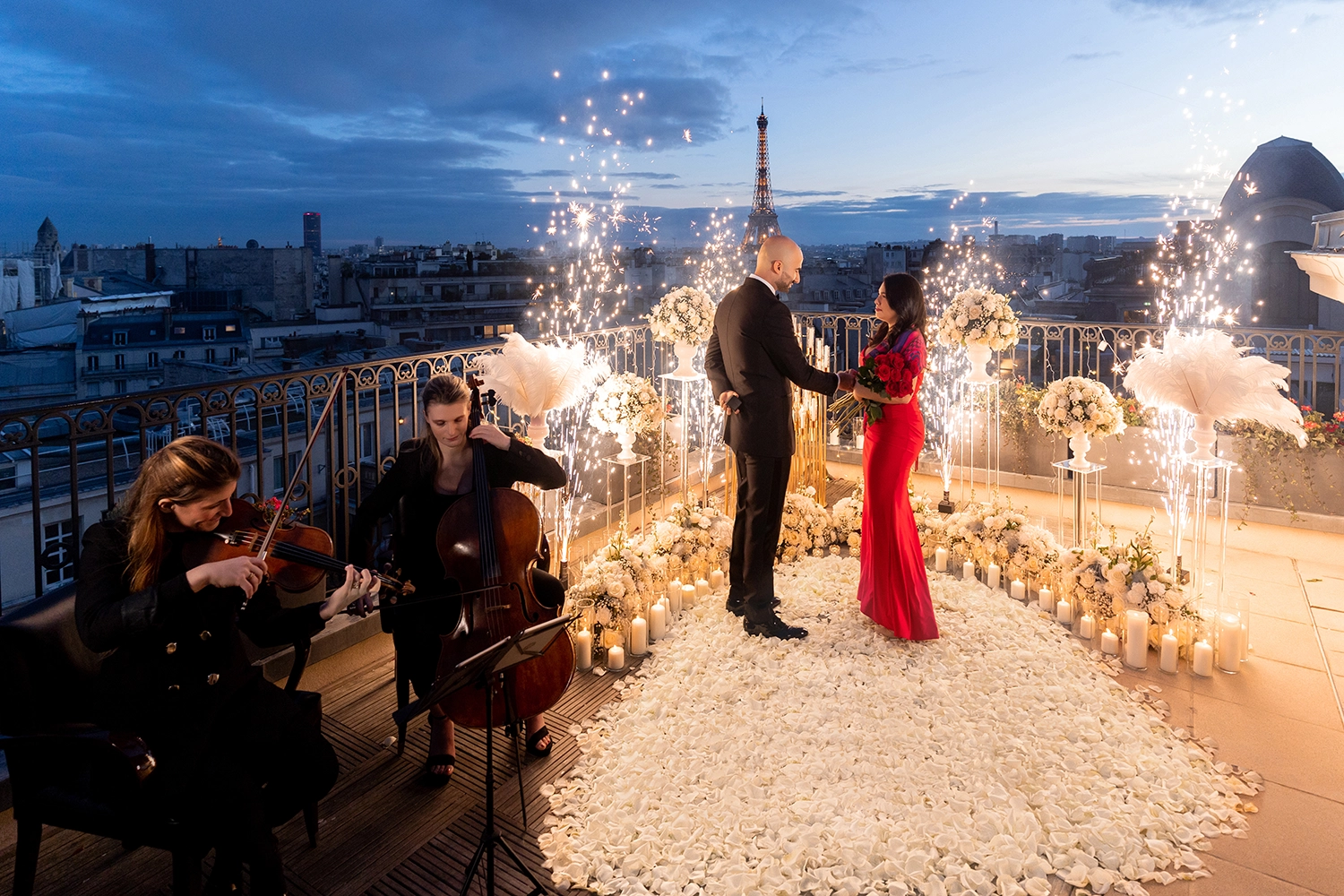
It depends on whether the setting is public or private, the date, the photographs and film you want, and what you are doing afterward. Paris in late June and Paris in December run on completely different clocks.
Early morning
Early morning mainly helps public proposals, because fewer people are competing for the well-known positions. Near the longest days of summer that means a brutal alarm, and you have to work backward through hair and makeup, getting dressed, and the drive, while she has no idea a photographer is already in place. If you landed from another continent the day before, sleep is worth more than technically better light.
The advantage comes afterward. You have the whole day ahead of you, so you can continue into engagement photographs while you are already dressed and with the photographer who just documented the proposal, and then go and have breakfast.
Sunset and blue hour
Sunset gives you several looks in one session: daylight, softer evening light, the turn toward blue hour, and eventually the illuminated Tower. The catch is that sunset does not happen at a convenient dinner hour all year. Near midsummer it is late, so if you want to propose around sunset, photograph afterward, and then sit down to dinner, check the restaurant’s service hours before you fix the proposal time. A beautiful sunset is little comfort when your newly engaged fiancée is hungry at 10:30 p.m. and the kitchen has stopped.
For photographs and film together, blue hour is often the most useful window of the day. Paris reads as evening while there is still light in the sky, so the Tower can be illuminated without the couple disappearing into a black foreground and the architecture around you stays visible.
After dark
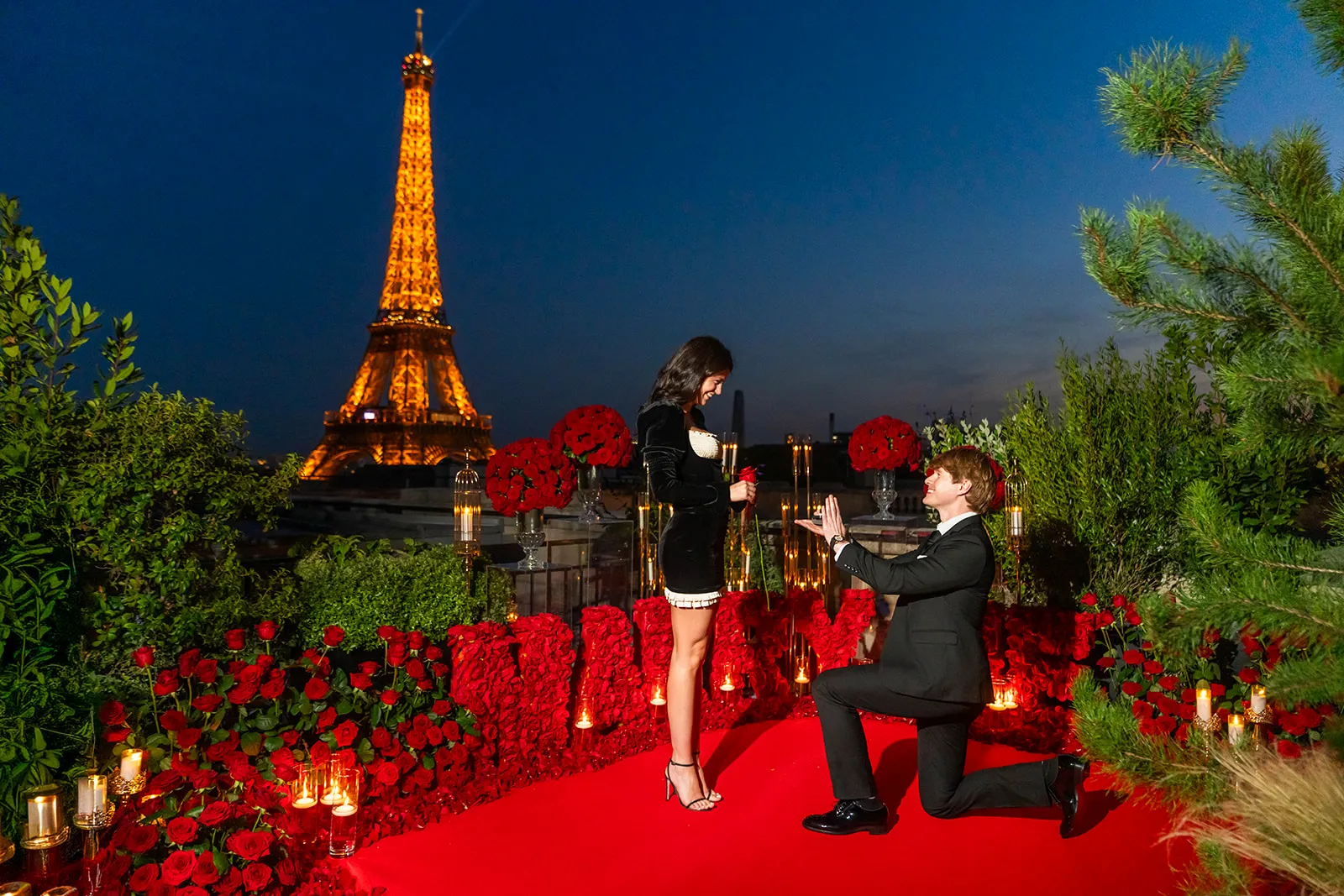
Night proposals can be spectacular, and the Eiffel Tower does not light the couple. Against an illuminated Tower, faces fall into shadow unless somebody has been made responsible for lighting them.
For a simple public proposal that means a discreet continuous light and an assistant who knows where to stand without turning the proposal into a film set. For a private setting with florals, a musician, dinner, and several camera angles, the lighting plan is larger and it is a separate line in the budget. Make sure the planner knows who owns lighting and that the photographer and filmmaker know what is being provided. If nobody can answer the question, assume nobody has solved it.
When does the Eiffel Tower sparkle?
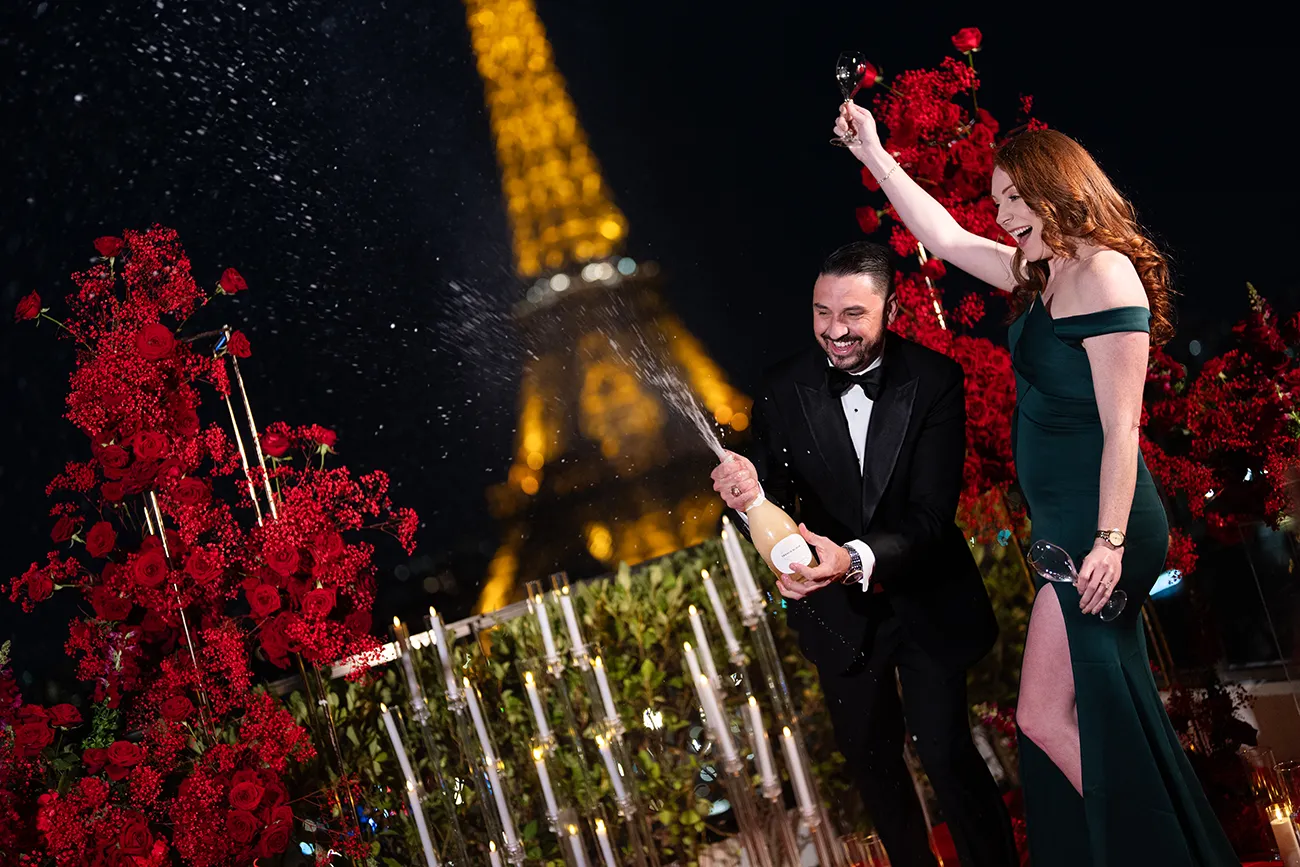
Once the Tower is illuminated after nightfall, it sparkles for five minutes at the top of each hour.
The important part is after nightfall. The golden lighting is triggered by ambient light rather than by a fixed clock time, so on a bright summer evening the official sunset can pass before the Tower looks the way you expected. There is also a last sparkle of the night, and it varies with the season, so confirm the time for your date rather than assuming it. Build enough margin into the plan that being five minutes late is not a disaster. There is another hour coming.
One question we are asked often: proposing very late to avoid the crowds. It thins some locations and it is not a general solution. Photography and film get more complicated after normal hours, after-hours vendor rates can change, transport needs more thought, the lighting plan becomes more important, and once the illumination is off for the night the Tower behind you is dark.
Plan a Paris proposal at night
What happens if it rains on an Eiffel Tower proposal?
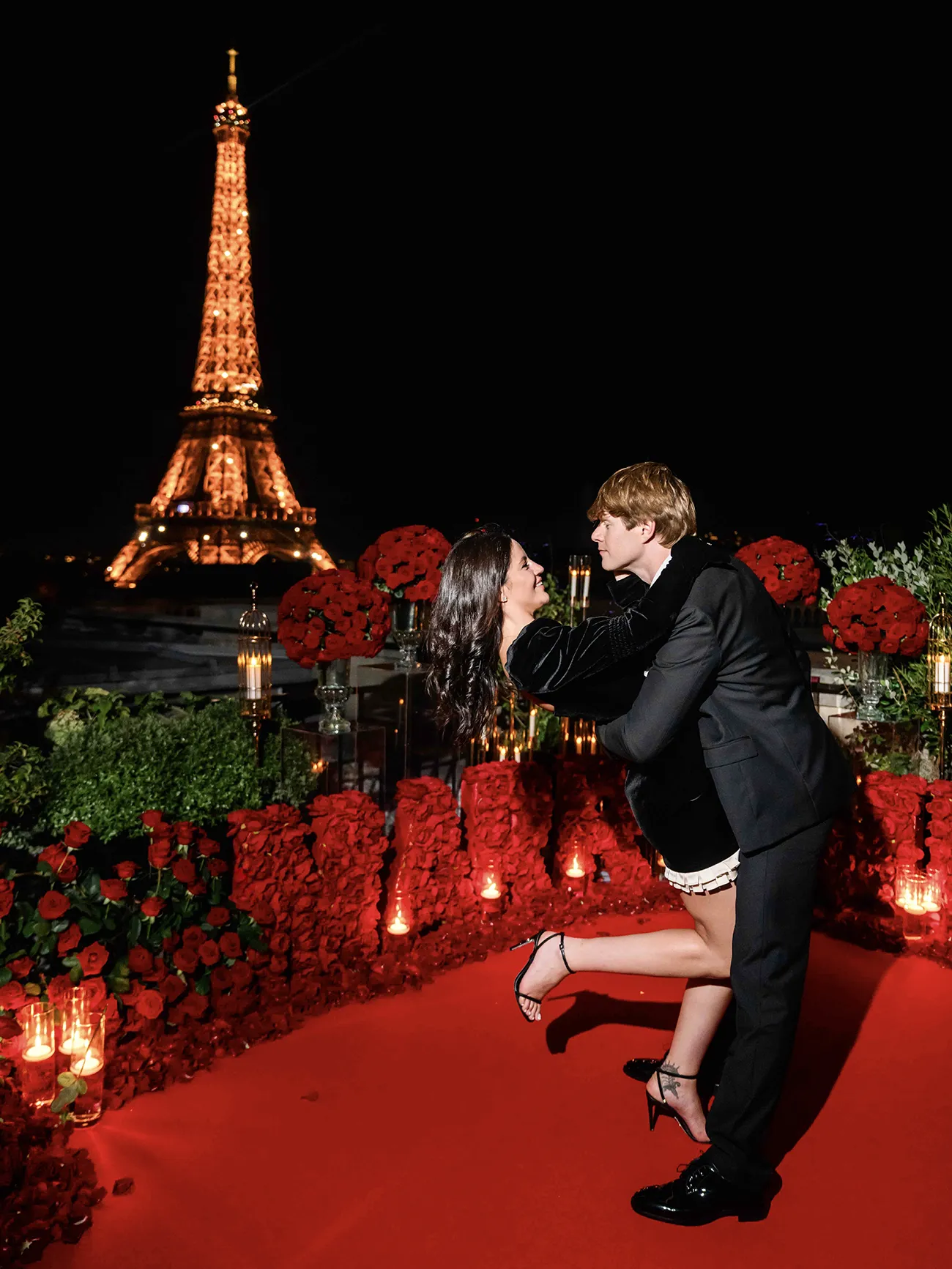
The rain plan depends on the setting. Private does not mean weatherproof.
In public there is no indoor room attached to the location. Light rain is often completely workable and can photograph beautifully. Heavy or persistent rain changes the photographs, her hair and makeup, the comfort of the whole thing, the musician’s equipment, the lighting, and how long you can reasonably stay outside. Moving under a bridge because it is dry does not preserve the proposal you chose: the Tower angle, the light, the noise, and the picture are all different under there. A real backup is a plan you would be happy to use, not simply somewhere with a roof.
On a rooftop, residential or commercial, you can still be fully exposed to rain and wind. Ask before booking what happens if the terrace cannot be used: whether there is an interior, whether it still has a Tower view, whether the proposal can move inside, whether the access time can move, and what happens to the florist, the musician, the photography, the film, and dinner.
In a room or suite, the interior may itself be good enough for the proposal, which is another reason the exact room category matters. If the terrace is unusable but the salon has floor-to-ceiling Tower views and room to work, you still have a real alternative. If the only worthwhile view is outside, the room has not solved the problem.
On the water, a boat may have an interior while the proposal deck stays outdoors. That protects the people rather than the photograph. A larger yacht gives you more room to move dinner, guests, and music inside; a small boat naturally has fewer options.
Ask that before you pay a retainer: what exactly happens if the outdoor position cannot be used.
What the setting changes after she says yes
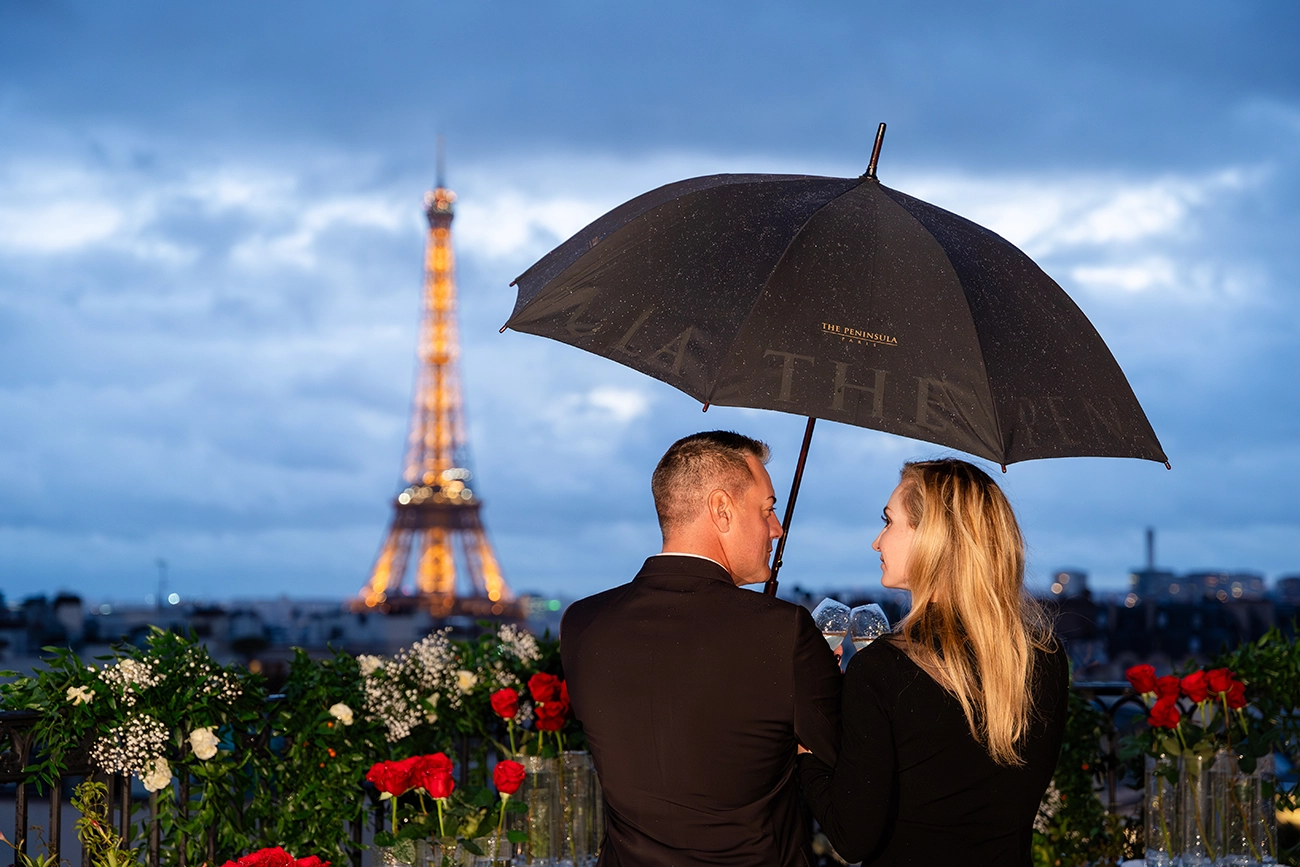
Plan the proposal and what follows as one day. The full framework is in our Paris proposal guide. What changes here is the sequence, and the setting decides it.
After a public morning proposal, photographs come first while the light is still useful and you are with your photographer, and then breakfast rather than pretending dinner is the next event at 8 a.m.. After a public evening proposal, take the photographs you want while you are still at the Tower, then move to dinner deliberately rather than standing beside the river working out where to go. A pre-booked car makes a real difference if she is in heels or dinner is across town.
After a private proposal, on a residential rooftop the proposal is usually the main event and the next address is part of the plan. At some hotel terraces dinner can follow at the same property. In the right room or suite, dinner and the first night can stay where you asked. On the Seine the proposal is the beginning of the cruise rather than the end of the booking.
See Paris restaurants with Eiffel Tower views
Real Eiffel Tower proposals
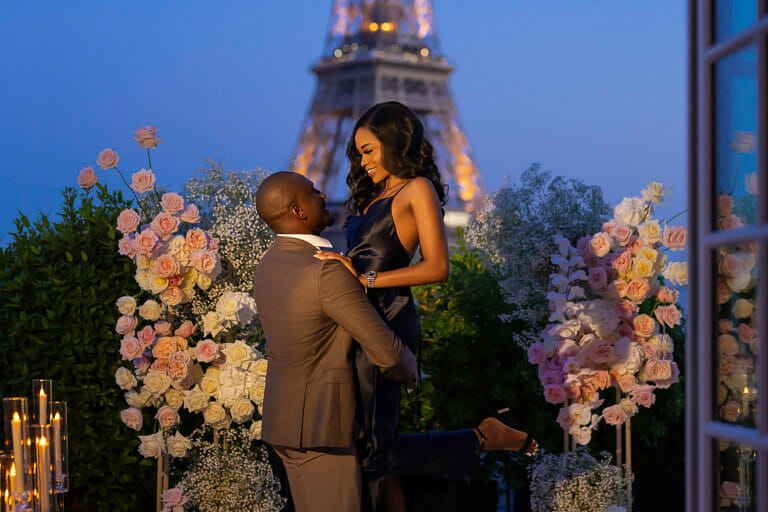
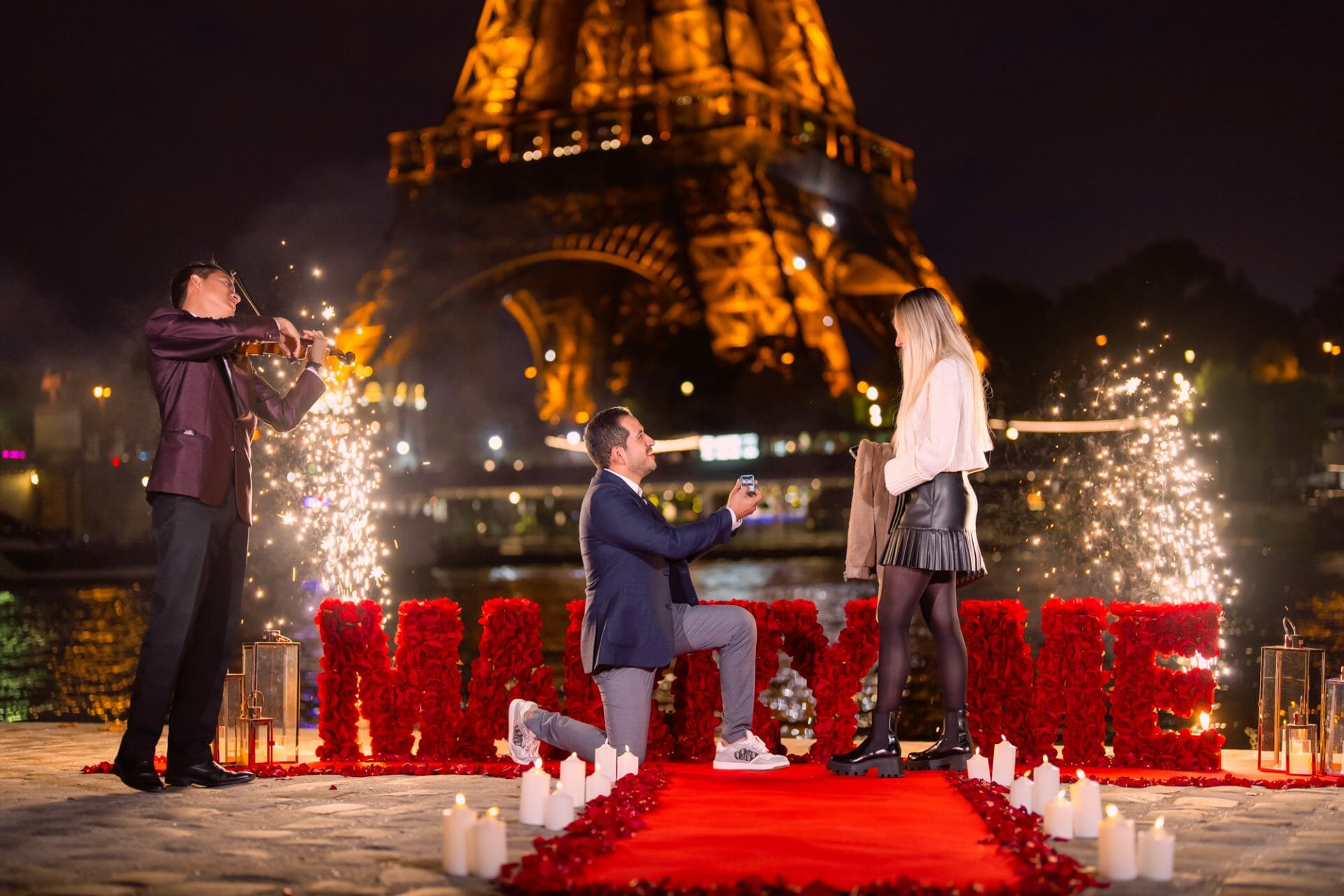
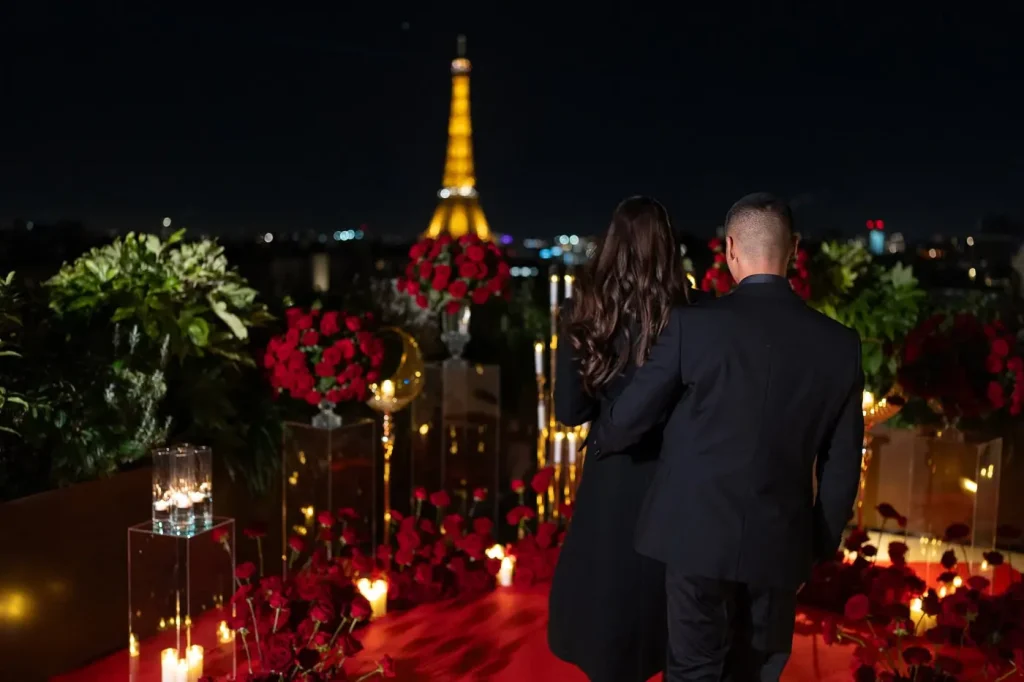
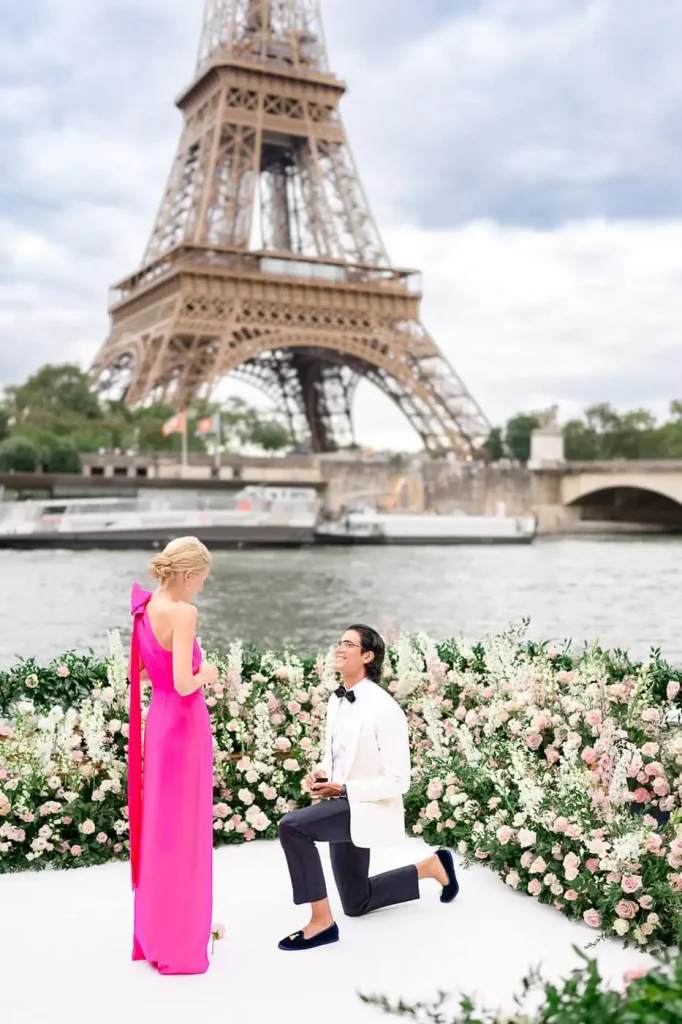
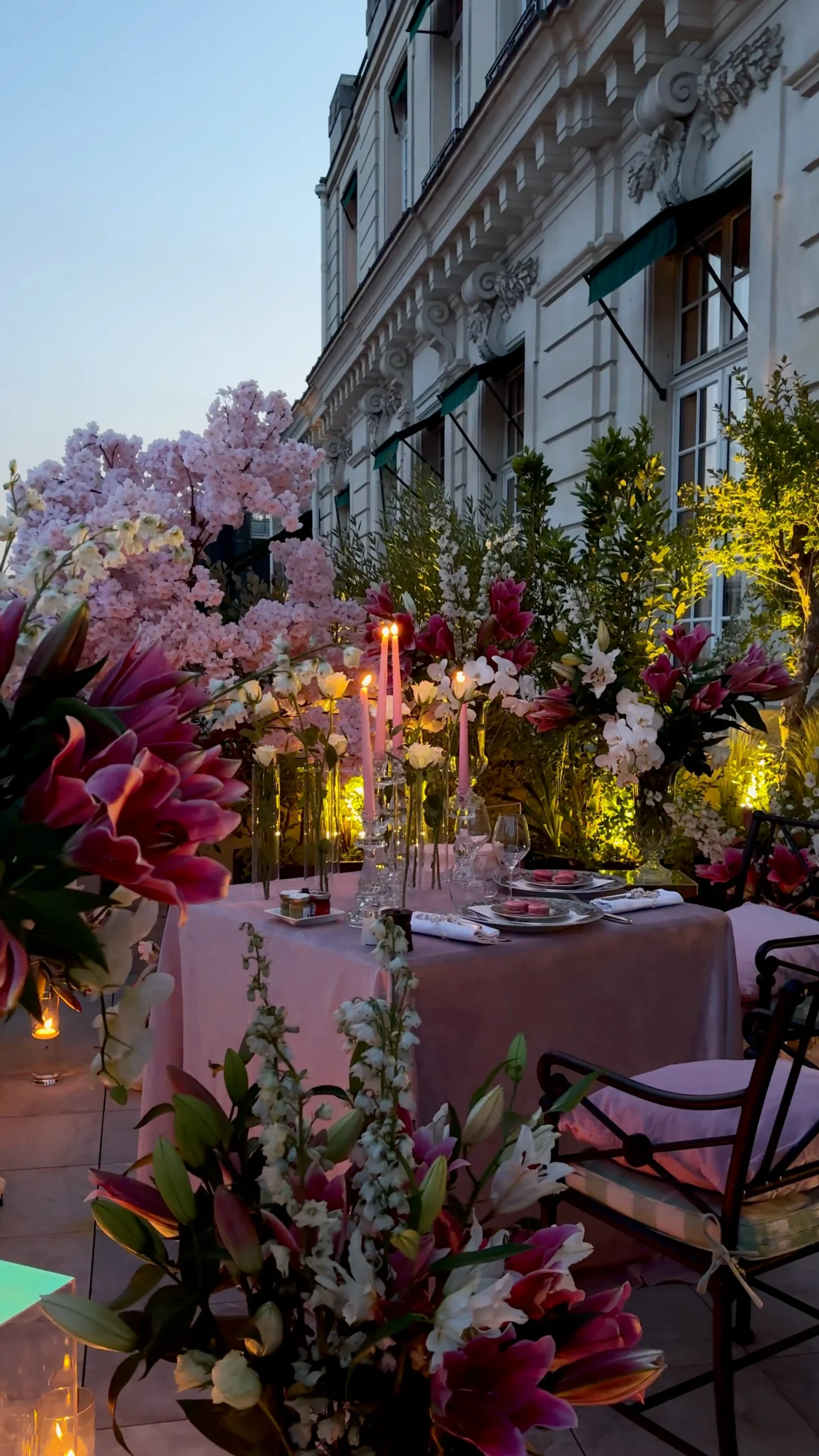
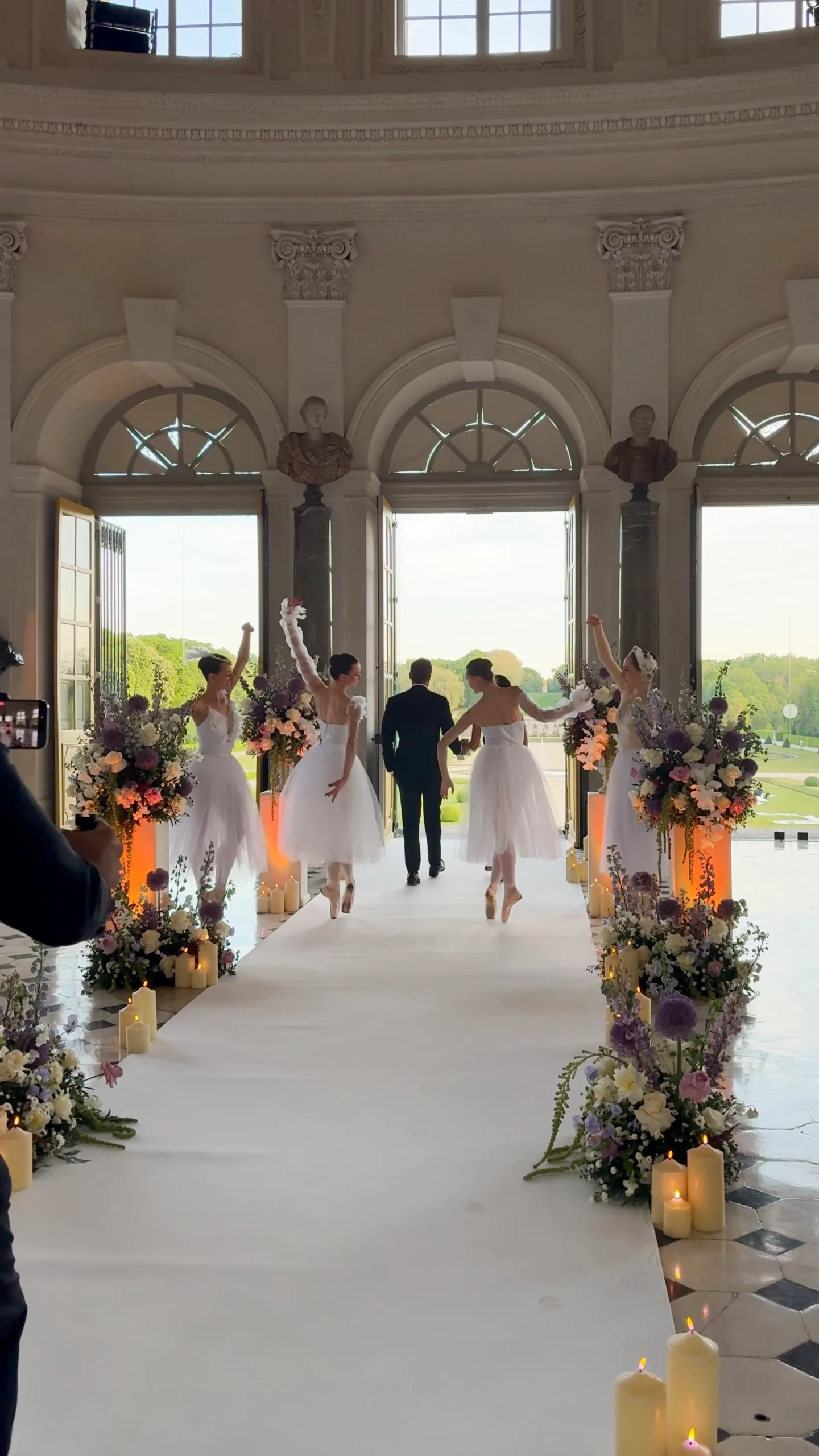
Watch Real EIFFEL TOWER proposals
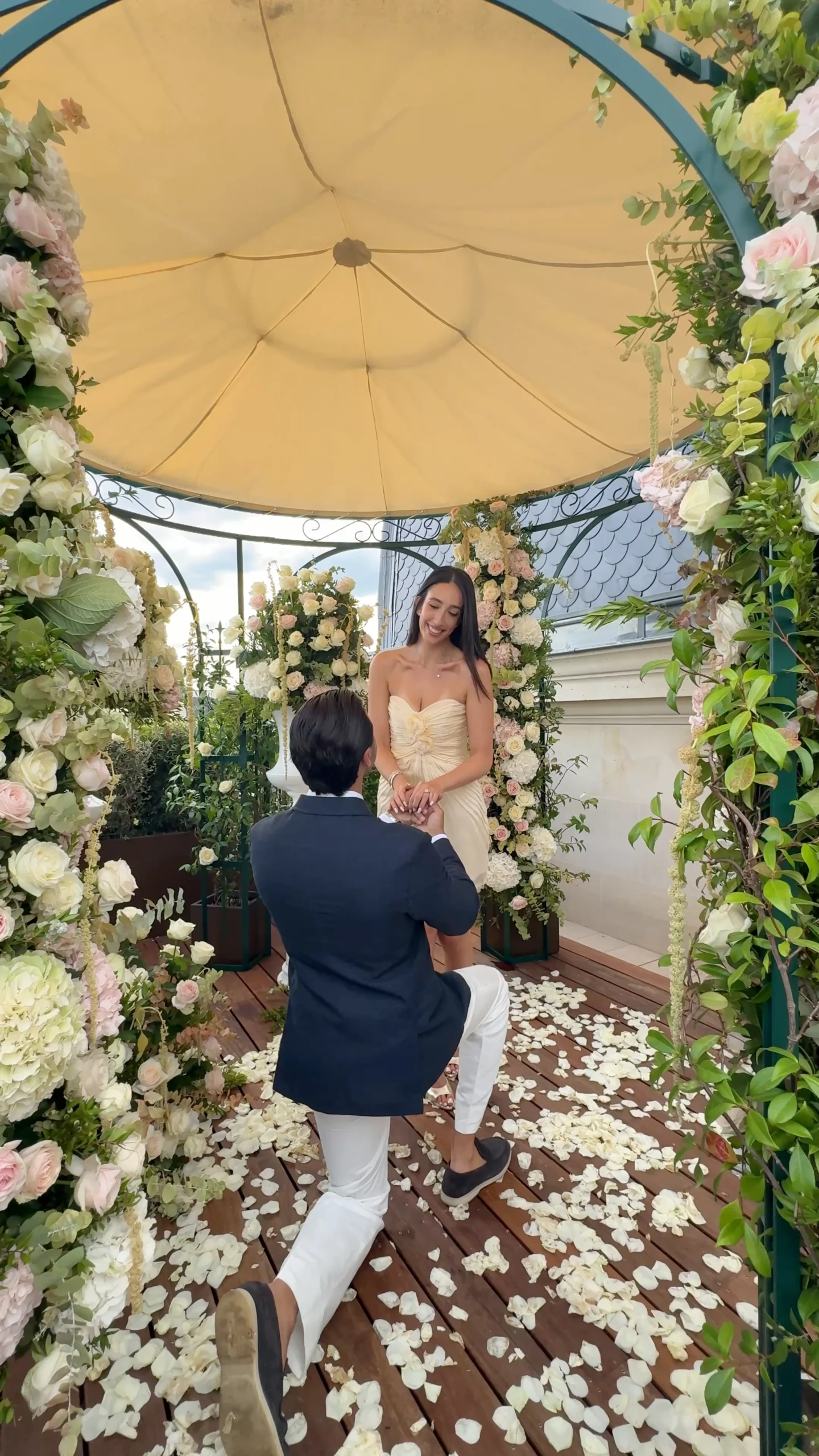
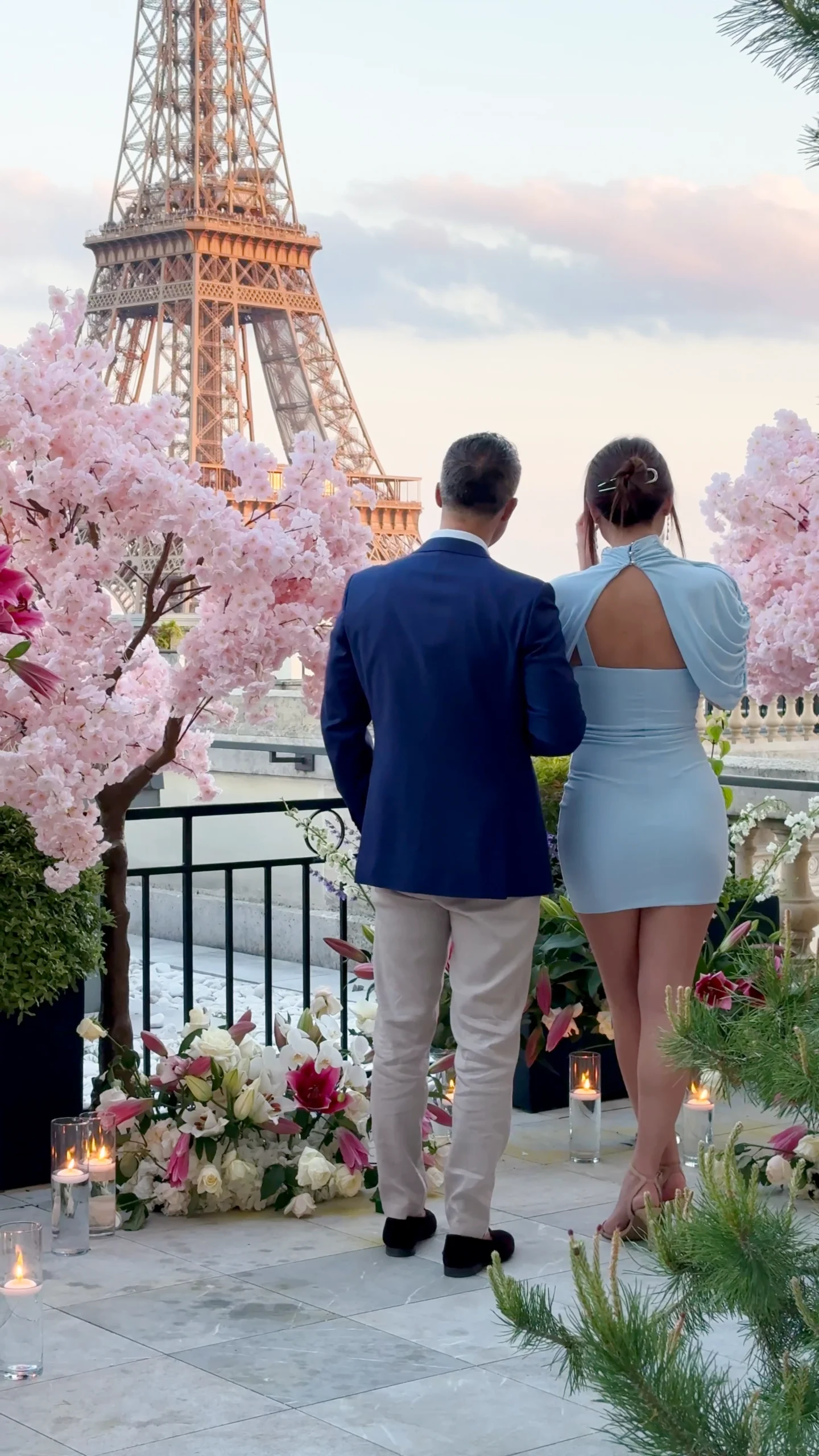
MORE PROJECTS
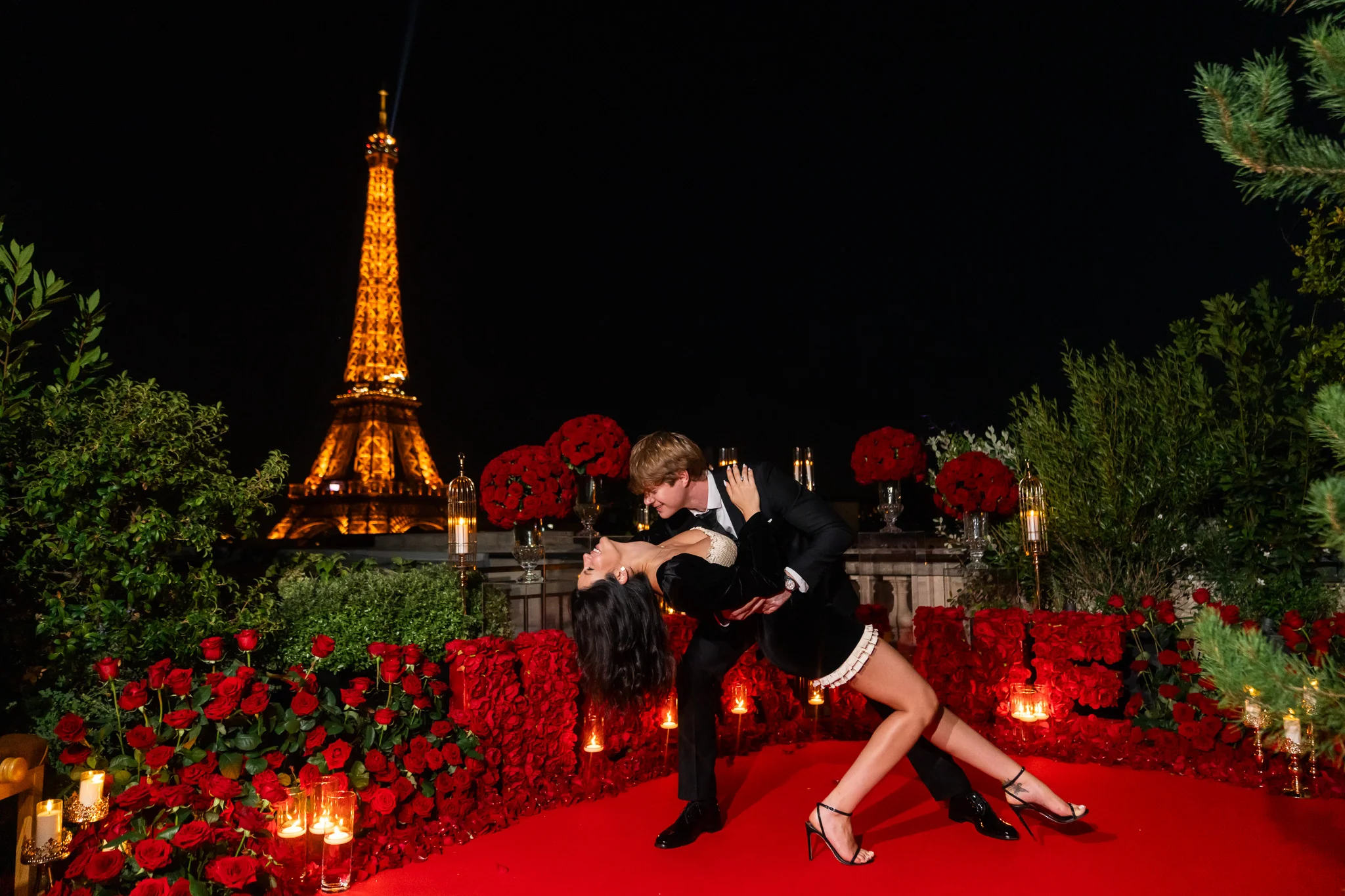
Shangri-La Paris Proposal
- ● Eiffel Tower
- ● Family
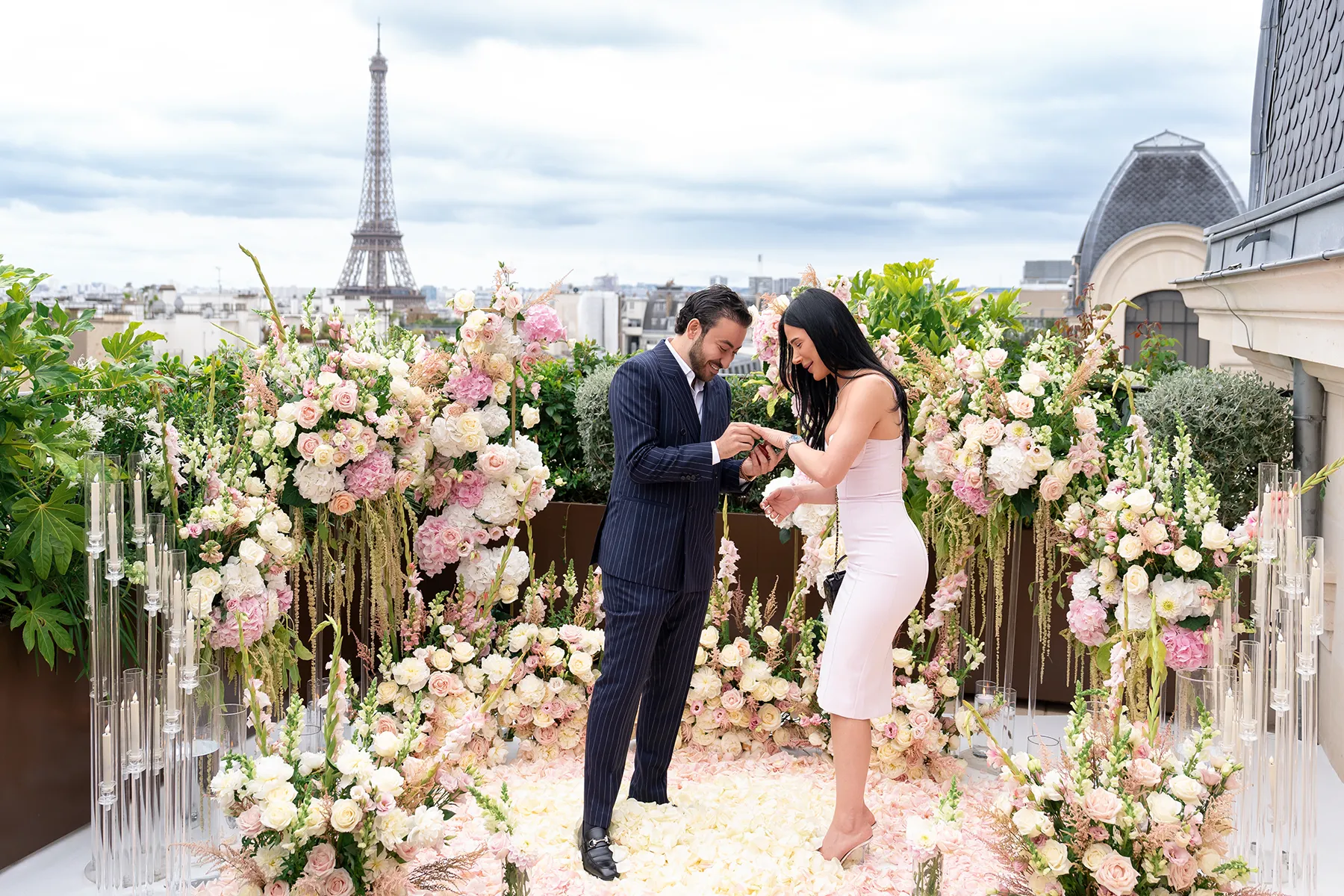
Peninsula Paris Proposal
- ● Secret Table
- ● Eiffel Tower
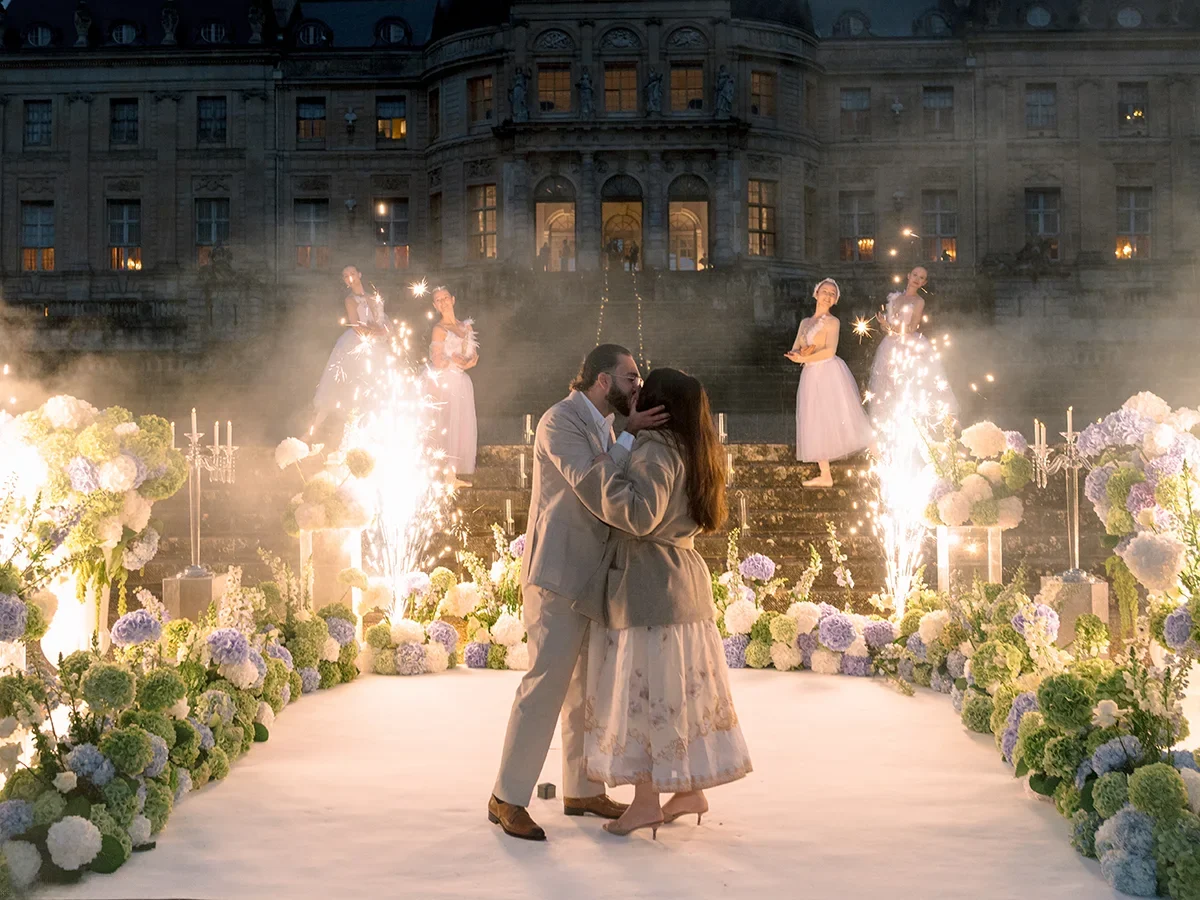
A Rainy VLV Proposal
- ● Château Proposal
- ● Vaux-le-Vicomte
Speak to us.
Your dates, your ideas, your questions — we’ll take it from there.