A Jewish Destination Wedding at Château Saint-Martin-du-Tertre Near Paris
A 240-guest modern Jewish destination wedding at a 19th-century château in the Val-d’Oise, an hour north of Paris — a chuppah at the rotunda, a late-summer dinner under the lit façade, three return coaches to Paris, and a four-day wedding week planned by Kiss Me in Paris.
A 240-Guest Jewish Château Wedding, Start to Finis
This was a 240-guest modern Jewish destination wedding at Château Saint-Martin-du-Tertre, an hour north of Paris, planned across four days by Kiss Me in Paris.
The harp and violin opened with Rufus du Sol’s “Innerbloom” just after half past six. The bride came down the aisle between her parents, mother on one side, father on the other — the Jewish processional — under the rotunda at the front of the château. The chuppah had been built that morning. It caught the last of the late-summer light.
Guests had arrived from six. They stepped off coaches that left central Paris an hour earlier, took a bellini at the welcome table, and the men chose a kippah from a white tray. The groom had walked in to Coldplay’s “Yellow,” his parents beside him. Both families gathered close. Two cups of wine. The ring. The ketubah, read aloud. Seven blessings. The wrapped glass under his foot. The first kiss.
By eight, the chuppah florals had become the dance installation. By nine, the band gave the room to the DJ. By midnight, two costumed dancers opened the Hora Loca, a Venezuelan tradition the bride grew up with. Three coaches carried guests back to Paris through the night: one at one, one at three, one at five.

Wedding Quick Facts
| Season | Late summer · Sunday celebration |
| Venue | Château Saint-Martin-du-Tertre, Val-d’Oise (north of Paris) |
| Guest Count | 240 |
| Ceremony | Modern Jewish ceremony under a chuppah, rabbi-officiated |
| Couple | Bride — Venezuelan-American with a French mother. Groom — American. |
| Planning Scope | Full-service · 18 months · KMIP-led, 16 vendors |
| Wedding Week | Thursday Crazy Horse Paris · Friday Shabbat dinner at Hôtel d’Évreux · Sunday wedding at the château |
Venue at a Glance
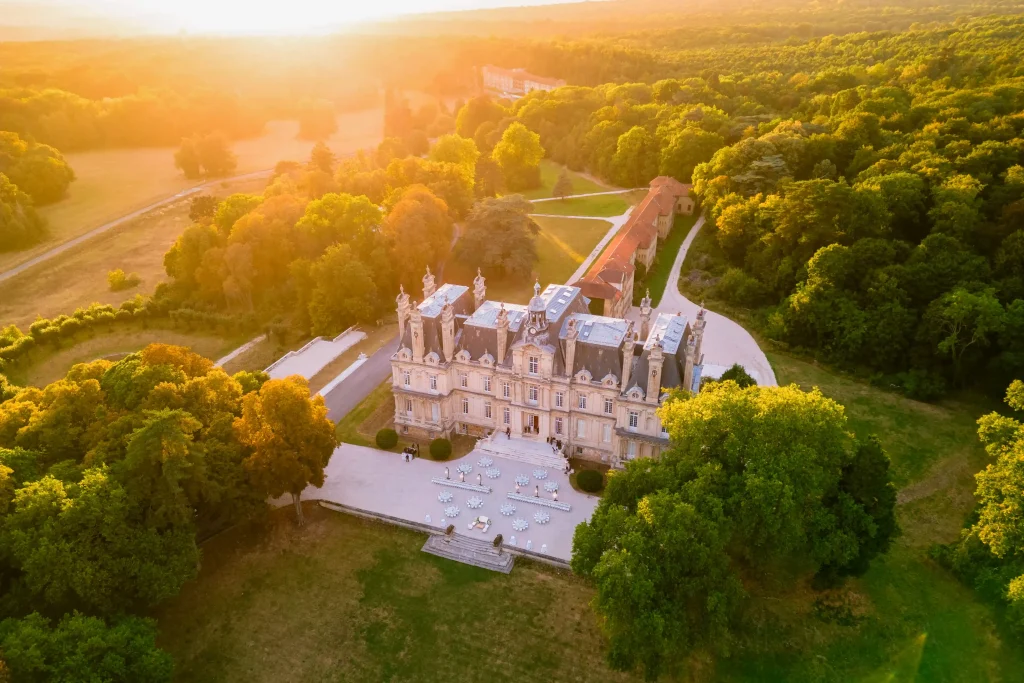
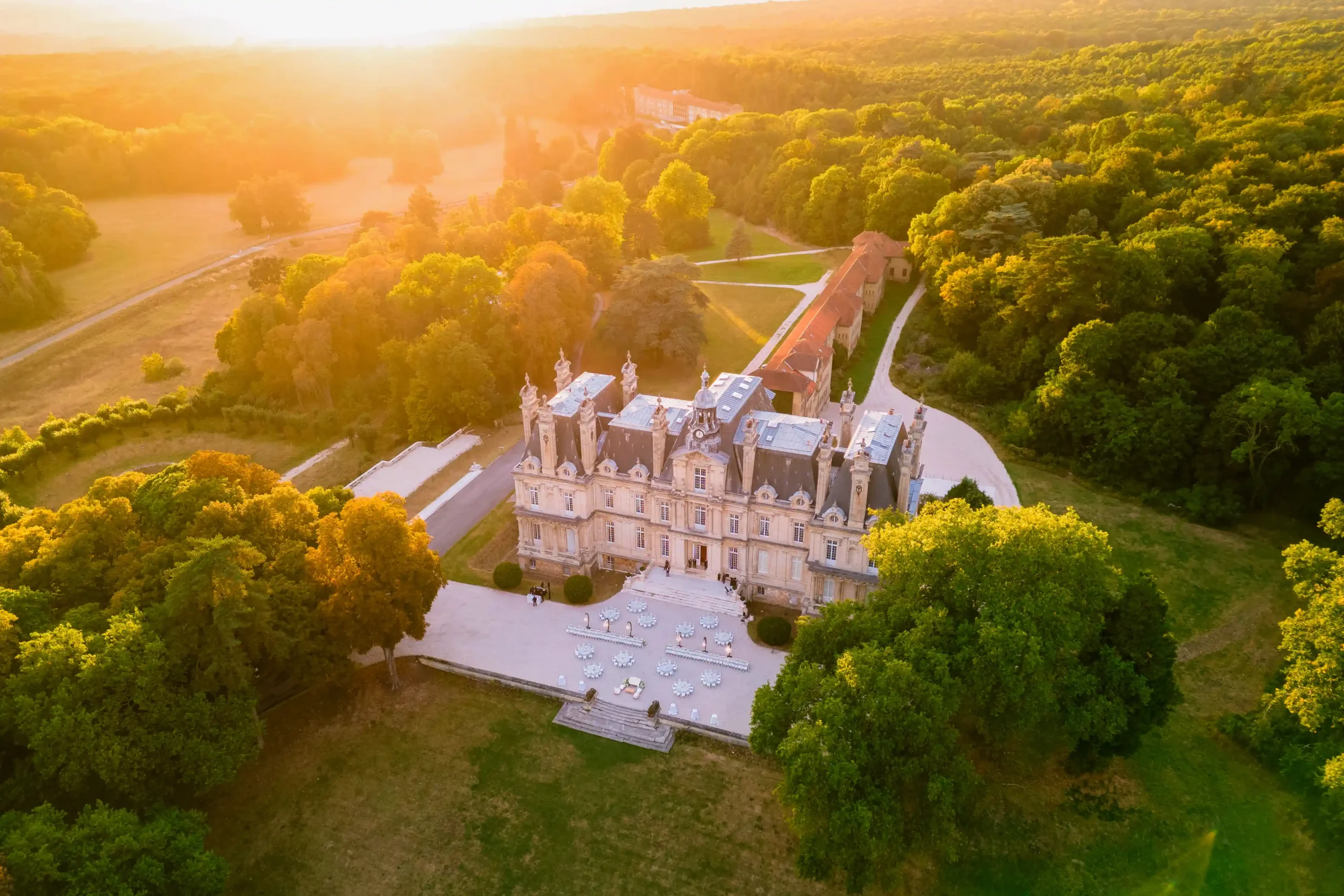
Château Saint-Martin-du-Tertre is a 19th-century estate in Val-d’Oise, what an American reader might call a French castle. The property allowed this 240-guest wedding to move through six guest zones across the evening: ceremony at the rotunda, cocktail hour on the gravel apron, buffet from the white room, dinner outdoors in front of the lit façade, dancing inside, and dessert in the library. Three return coaches to Paris were staged through the night.
| Seated Capacity | Up to 340 across the connected salons · 220 in the Salle de Gala (440 standing there for a cocktail) |
| On-site Beds | Up to 32 guests — close family and bridal party |
| Grounds | 42 hectares (over 100 acres) of private parkland and forest |
| From central Paris | Just over an hour — plan a one-hour-plus coach window |
| From CDG / Orly | ~30 minutes from CDG · 70–100 minutes from Orly (route guests via CDG) |
| Outdoor ceremony options | Rotunda, esplanade, colonnade, pond — this couple chose the rotunda |
What the Couple Wanted: A Modern Jewish Wedding at a French Château
The couple wanted Paris, but not the postcard. The bride had spent childhood summers in France with her French mother; the groom knew the difference between a hotel ballroom and a working château. For 240 guests flying in from the US, Venezuela, and France, they wanted a real French estate — grandeur with weight behind it — and the ceremony outside, in front of a building that had stood since the 19th century.
The religious brief carried equal weight. This was a modern Jewish wedding with the full ceremonial structure: a chuppah, the ketubah signed in private with witnesses before the procession, two cups of kiddush wine, seven blessings, and the wrapped glass underfoot. All of it sits in the run-of-show from the first scheduling call, never bolted on at the end.
Then the cultural layer. The Venezuelan side wanted a Hora Loca at midnight with costumed dancers. The bride’s French mother had specific songs for dinner, pieces from her own childhood. What the couple wanted their guests to feel was that a French wedding could be Venezuelan and Jewish and American at once, with none of it muted. The greeting at the door was a bellini and a kippah. The dancing went from grass to a parquet floor by one. By five, the bride and groom were still there.

Why this Château Near Paris Worked for 240 Guests
For a 200-plus-guest wedding near Paris, the choice usually comes down to two: a central-Paris hotel ballroom with stricter late-night limits, or a château outside the city with the run of the property. Few venues hold both well.
The real options at this size are short — Château Bouffémont, Château de Champlâtreux, Château de Ferrières, and Saint-Martin-du-Tertre. This couple visited five before deciding. Saint-Martin-du-Tertre won on four counts.
It sleeps the inner circle. Up to 32 guests stay on-site, across double rooms and family suites — so the people who had to be there early never had to commute. Family slept where the wedding happened.
It holds 240 without crowding. The château seats up to 340 across its connected salons, with 220 in the Salle de Gala. Six guest zones carried the evening: the rotunda for the chuppah, the gravel apron for dining, the white room for the buffet, the interior salons for the late-night party, the library for dessert.
It allows a party until daybreak. Many Paris hotel weddings face stricter late-night limits than a private château. This couple wanted Hora Loca at midnight and dancing until breakfast, and the château allowed both.
The building does its own work. What you don’t see on a first visit is what the façade does at sunset: a slow pink-and-yellow wash across the limestone that holds through the dinner hour. It was not installed for the wedding. It comes with the building. Dinner went outside, in front of it, on the first walk-through.
The trade-off is honest: this is not central Paris. The estate sits in the Val-d’Oise, just over an hour from the city, which made guest coaches and a wet-weather plan non-negotiable. In August, both were.
The right couples for Saint-Martin-du-Tertre bring 150 to 300 guests, want a real party over a hotel curfew, plan a multicultural or religious ceremony, and want their inner circle sleeping on-site.

A Modern Jewish Ceremony at the Rotunda
This was a modern Jewish ceremony with the full traditional structure, set at the château’s stone rotunda. The ketubah had been signed earlier in the library, witnessed before the procession. The wrapped glass sat in position under the chuppah; the two cups of kiddush wine waited on the table.
Half past six. Guests had been on-site thirty minutes, met with bellinis on the gravel terrace and a kippah from a white tray at the entrance. The chairs faced the rotunda, where the chuppah had gone up that morning.
The bridal party came first: ten pairs. Two ring bearers, then two flower girls with white-petal baskets. The groom entered with his parents to Coldplay’s “Yellow.” A pause. The harp and violin shifted into Rufus du Sol’s “Innerbloom,” and the bride came in with both her parents — the Jewish tradition of being walked in by mother and father together.
Under the chuppah, both families gathered. Two cups of kiddush wine, lifted and shared. The ring. The ketubah, read aloud. Seven blessings, in order. The wrapped glass underfoot. The first kiss. The rabbi closed, and the couple walked back up the aisle, the bridal party behind them.
The couple stepped away for a few private minutes inside the château before cocktail hour. By the time they came out, the terrace was full.

Guest Logistics
Guest logistics at a château an hour from Paris come down to transport, bars, and a dinner that doesn’t break the dance schedule. Cocktail hour opened outdoors on the gravel apron the moment the ceremony ended, with two bars — one outside, one in — across three phases: bellinis on arrival, paired wines through dinner, signature cocktails after. The signatures sat pre-mixed on the bar, so no one queued.
The cocktail-and-dinner band played outside — saxophone, keys, vocals — with a French vocalist during dinner for the songs the bride’s mother had asked for. For 240 guests, the buffet was a clock decision: plated service would have pushed dinner past nine and collapsed the dancing. The buffet fed everyone inside 75 minutes while guests moved between indoor and outdoor tables under a loose seating plan. By 9:15, the room was pulling people inside.
Wedding-Day Timeline for 240 Guests
| Time | Guest Experience |
|---|---|
| 5:00 PM | Coaches depart central Paris |
| 5:45 PM | Coaches arrive and stage at the château |
| 6:00 PM | Guests disembark. Bellini on arrival. Men collect a kippah from the welcome table. Women offered shoe covers |
| 6:15 PM | Guests seated at the rotunda |
| 6:30 PM | Ceremony begins |
| 7:30 PM | Cocktail hour begins. Live band. Two bars open |
| 7:45 PM | Buffet dinner opens — stations inside and outside |
| 9:15 PM | Doors open inside; dance-floor reveal with chuppah florals overhead |
| 11:00 PM | Dessert station opens in the library |
| 12:00 AM | Hora Loca enters with two costumed dancers |
| 1:00 AM | First return coach to Paris (89 seats) |
| 1:30 AM | Late-night snack station opens |
| 3:00 AM | Second return coach to Paris (89 seats) |
| 5:00 AM | Third and final return coach to Paris (89 seats) |
| 6:00 AM | Property cleared. Strike complete |

Design Direction: A Green-and-White Château Wedding
The palette was green and white. Most château weddings default to white-on-white — ivory linen, white florals, pale stone — and the contrast disappears the moment you walk in. This went the other way on purpose: seafoam linen, garden-toned florals, vegetation-heavy installations, white kept as accent. The result read more garden than gala, with the limestone façade behind it carrying the formality.
The chuppah at the rotunda was heavy on greenery, white florals at its four corners. After the ceremony, those same florals moved inside and were rebuilt as the dance installation — the chuppah had been engineered to break down and reassemble, so the most labor-intensive piece of décor on the property got two lives in one night.
Inside, the tables wore seafoam linen, ivory plates, garden glassware, and candelabra down the length of the room. The exterior tables on the gravel apron took lower candles and garden florals, set during the ceremony so guests hadn’t seen them earlier in the day.
Lighting worked in two registers. The château’s own façade wash — that slow pink-and-yellow gradient across the limestone — drove the exterior design from the first walk-through; dinner went in front of the building to put guests inside that light. Indoors, production lighting carried the dance-floor wash, the rig over the band, and warmer accents along the tables.
Paper, escort cards, and the welcome signage carried green ink on cream stock — the real test of a design language. It has to hold on the small surfaces, not just the big ones.
The interior reveal at 9:15 took that language into the party. The dance program had three layers: the cocktail-and-dinner band finished outside and struck by nine; the DJ took over from nine into the early hours, sliding from house through electronic; at midnight, two costumed dancers brought the Hora Loca — the Venezuelan tradition where masked performers turn the floor into a parade — written into the run-of-show from the earliest design meetings, so the Venezuelan guests felt it land at the right hour.
Dessert opened in parallel: at eleven, the library set out a multi-tiered buffet, so guests could break from the floor without leaving the party. Bringing dessert into the main room would have flattened the momentum. The kitchen left at two but stocked snacks through the night, so anyone still there past three was never hungry. By six, the property was empty and ready for strike.

The Bride’s Look and the Beauty Timeline
The bride dressed in a suite upstairs — strapless, structured, a pleated bodice, a train that spread across the floor. The photo and film teams worked the get-ready hour close: the dress, the mother adjusting the veil, the jewelry chosen and clasped, the bouquet handed over. It is one of the strongest emotional sequences in the gallery.
The veil stayed folded through the get-ready hour; once she was ready, it went on for the walk down the aisle.
The bridal party wore soft seafoam against the deeper greens of their bouquets. Hair and makeup started at one, the bride in the chair by two and finished by five, a 5:15 first look in the gardens, family portraits at 5:30 — both sides choreographed against a guest arrival that began at six sharp.

// How KMIP Handled a Power Cut During Dinner.
The lights went out across the château just as dinner began.
Main floor, white room, the façade wash outside — all of it, at once. Within minutes, the planner had the château’s owner on the phone. Five minutes after it started, the power was back. The bride’s mother asked the planner, later, what had happened. By then dinner was on schedule and no one at the tables had noticed the gap.
This is what full-service planning at this scale protects: the room keeps moving, even when the building doesn’t.
What a Paris Destination Wedding Planner Handled
Across eighteen months and one wedding day, KMIP led the planning and the production as a Paris-based destination wedding planner for international couples. The work, by category:
Planning and design. Venue search, château shortlisting and visits, design palette, paper goods, music brief, dietary planning, schedule, run-of-show. Creative direction and lead planning: Chantelle Streete.
Wedding-week program. Three connected events across four days (see the planning timeline below).
Religious and cultural coordination. Rabbi sourcing, briefing, confirmation. Ketubah signing with witness coordination in the library before the procession. Chuppah staging in the ceremony order. Wrapped glass in position. Schedule built around the Shabbat window. Hora Loca timing and dancer cue at midnight. Music handoffs between the harp-and-violin duet, the band, and the DJ.
Vendor management. Contract negotiation, deposits, schedule alignment, walk-throughs, day-of supervision, payment release, and post-event reconciliation across sixteen wedding-day vendors and a six-vendor rehearsal dinner.
Venue paperwork and access. Production schedule, vendor list, and timeline submitted to château management in advance. The €10,000 security deposit handled. Build-day load-in sequenced from ten in the morning across six vendor teams.
Guest logistics. Coach coordination Paris–château–Paris, three return trips between one and five in the morning. Welcome-table setup with bellinis, kippahs, shoe covers. Hotel block in central Paris for guests not sleeping on-site. Dietary preferences captured per guest and passed to the kitchen, including kosher options for guests who required them.
Weather plan. Plan B held in reserve through the morning, watching radar from breakfast on; Plan A confirmed once conditions cleared by early afternoon. For heat, the ceremony sat at 6:30 rather than mid-afternoon, with shaded circulation built into the run-of-show and the limestone interiors — high ceilings, shutters — staying naturally cool.
Day-of direction. Six KMIP team on-site from ten in the morning to six the next morning — build, run, and strike.
Planning a Multi-Day Destination Wedding in France
Planning took eighteen months, led by Chantelle Streete on creative direction and lead planning, with Margaux Carret in support across the back half. Six KMIP team worked the day itself.
01
Twelve to eighteen months out
We lock the venue and the religious framework
Five French châteaux visited before deciding. Saint-Martin-du-Tertre met the brief on four counts: rooms for the inner circle, capacity for 240, late-night freedom, the building’s own façade lighting. From there, the rabbi sourced for the Val-d’Oise, ketubah signing scheduled with witnesses, the chuppah and ceremony order set, the Sunday timing built around Shabbat — which closes Friday at sundown and runs through Saturday.
02
Thursday Night
Family evening at the Crazy Horse Paris
A coach collects the couple and their immediate family from the InterContinental Paris and brings them to Avenue George V for a private cabaret evening. The week opens on the couple’s terms, not the guest list’s.
03
Friday Night
Shabbat dinner at Hôtel d’Évreux
Rehearsal dinner and Shabbat in one. A long-table dinner in the inner courtyard of an 18th-century hôtel particulier on Place Vendôme. The palette previews Sunday directly — green tablecloths, candelabra down the table, garden greenery, black Napoleon chairs against limestone and arched windows. By Sunday, the color language is already in the family’s eye.
04
Sunday
The wedding
Saturday stays open by design — Shabbat observance and rest. Sunday at the château: sixteen vendors, six KMIP on-site, ceremony at half past six, dinner outside under the façade wash, dancing inside from half past nine, three return coaches between one and five.
Gallery


WATCH our Shorts




Vendor Ensemble
- Venue · Château Saint-Martin-du-Tertre
- Planning & Design · Kiss Me in Paris
- Décor & Florals · AS Luxury
- Linens & Interior Tables · Events in Paris
- Catering · Armand Ohana
- Photography · Catalin Vutcariov
- Film · Anton Yasirov with Sabrina Yasirova
- Bar · L’Îlot Cocktails
- Ceremony Music · Santiago Falcon & Marj
- Reception Band & Hora Loca Dancers · Whisper Note
- DJ · Rikixl Da Silva Masllorens
- Hair & Makeup · Kassaundra Beauty
- Production Lighting · Blackstone Entertainment
- Living Statues · Scarlett Entertainment
- Welcome Signage · Maaida Paris
- Transport · Coach and Car
Why International Couples Plan With KMIP
From the planner: eighteen months, sixteen vendors, 240 guests, three continents, a four-day wedding week, a modern Jewish ceremony with the full traditional structure — and one five-minute power cut that no one at the tables registered. The couple set the brief: a real French château that could also hold a Hora Loca at midnight. The team built around it.
KMIP works with international couples planning a French wedding from another country — English-first across time zones, French vendor contracts handled, venue paperwork filed in advance. KMIP has planned and produced more than 1,200 events in Paris since 2013. Chantelle Streete (Wharton MBA) leads creative direction across the destination wedding portfolio. Press coverage spans 84+ outlets, including Reuters, AFP, CNN, Tatler, ELLE, TIME, and Vogue. One lead planner, from contract to strike.
// FAQ
What does a Paris destination wedding planner handle for a château wedding near Paris?
A Paris destination wedding planner handles venue, design, vendors, guest transport, ceremony coordination, and day-of production — contract to strike. For this 240-guest wedding, that meant sixteen vendors, three return coaches, and six KMIP team on-site across an eighteen-hour day.
Can KMIP plan a Jewish destination wedding in France?
KMIP plans modern Jewish destination weddings in France: chuppah, ketubah signing with witnesses, kiddush, seven blessings, and the breaking of the glass. Rabbi sourcing for the date and venue is the most variable piece; KMIP coordinates introductions or works with the couple’s own rabbi.
Can foreign couples legally marry in France?
Foreign couples rarely complete a French civil marriage, which requires one partner to establish thirty days’ local residency. Most marry legally at home and hold a symbolic or religious ceremony in France — full ceremonial weight, without the residency rule.
How far is Château Saint-Martin-du-Tertre from Paris?
Château Saint-Martin-du-Tertre is just over an hour from central Paris and about 30 minutes from Charles de Gaulle Airport. International guests route through CDG; Orly typically runs 70 to 100 minutes.
How do guests get back to Paris after a château wedding?
Guests travel back to Paris by private coach, staged across the night so no one is forced onto a single departure. For this wedding, three 89-seat coaches ran at 1, 3, and 5 a.m., after dancing that went to dawn.
How much does a wedding at Château Saint-Martin-du-Tertre cost?
The château’s published privatization packages range from €18,900 for single-day exclusive use to €38,900 for the three-day package with 32 beds on-site. KMIP’s planning fee is custom-quoted and sits on top of the venue hire and vendor spend.
Do I need to speak French to work with KMIP?
No — KMIP works entirely in English with international couples, handling French vendor contracts, venue paperwork, and all on-site communication in French on your behalf.
Speak to us.
Tell us what you’re thinking. We’ll be in touch within 24 hours.